
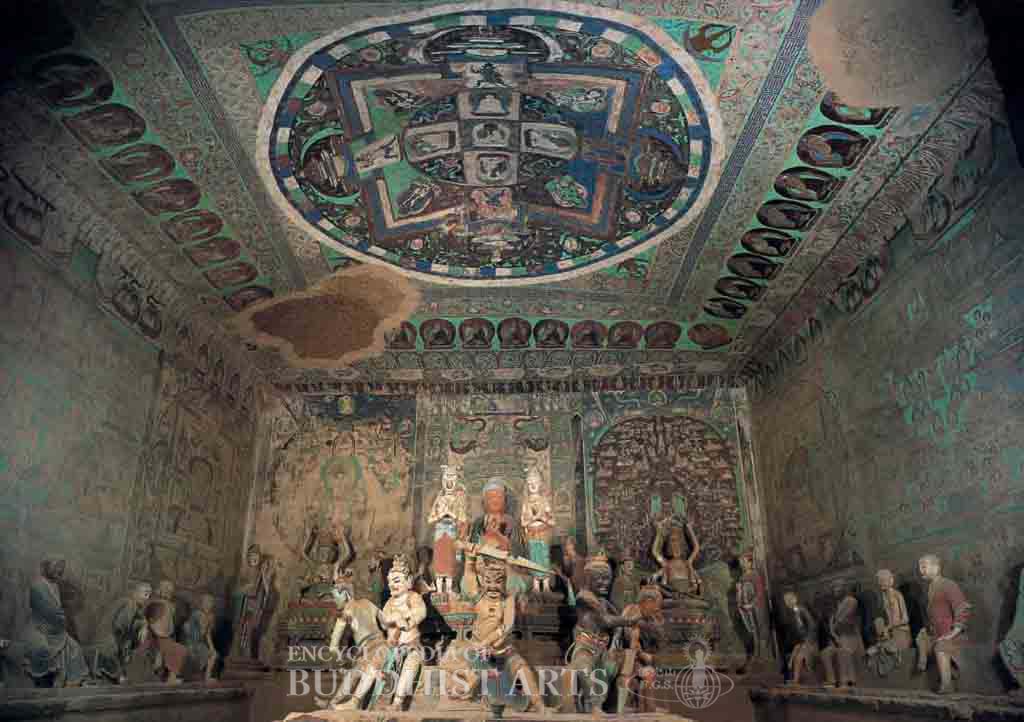
Yulin Cave 3
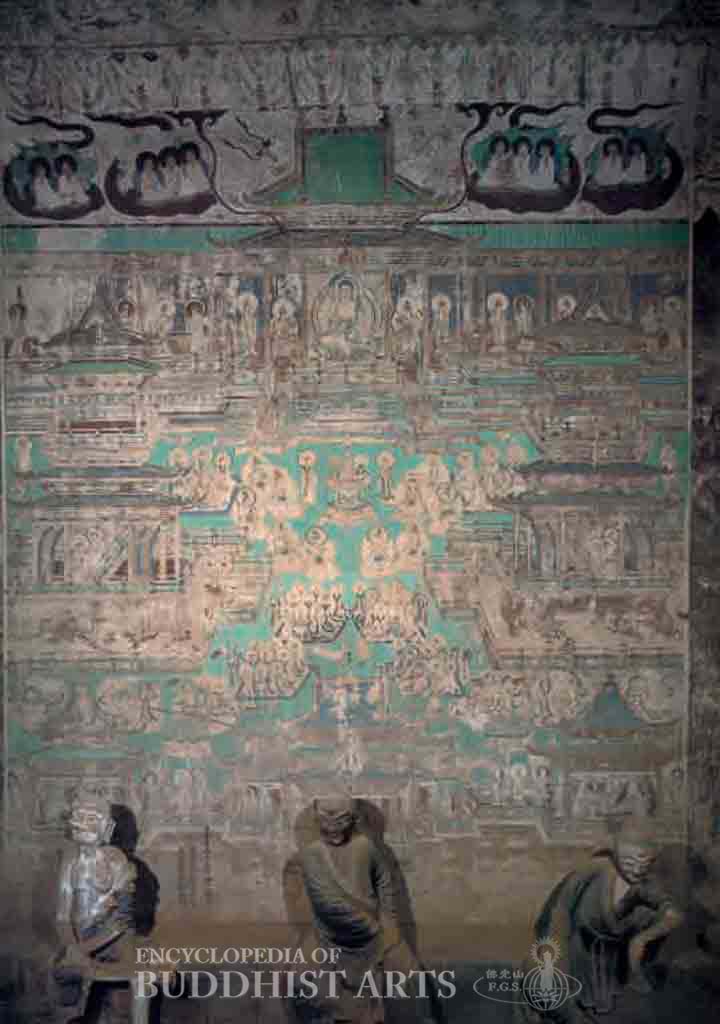
Yulin Cave 3: Illustration of the Amitabha Sutra (north wall)
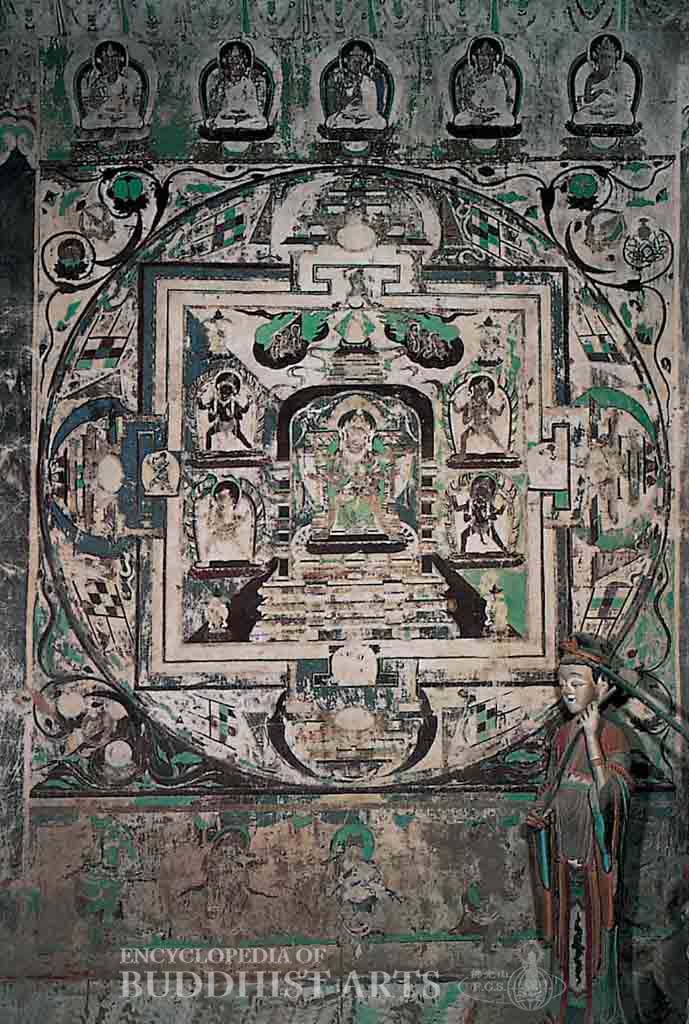
Yulin Cave 3: Amoghapasa Avalokitesvara Mandala (north wall)

Yulin Cave 3: Heavenly King (central platform)
Yulin Cave 3
CHINA, Gansu, Guazhou
Cave 3, located on the east cliff, was excavated during the late Western Xia period (1032–1227), and was renovated in the Yuan dynasty (1271–1368). Among the Yulin Caves, this cave contains some of the better works of Western Xia. The cave contains Vajrayana Buddhist artworks from both Chinese and Tibetan Buddhism. Remnants of the artworks show more Vajrayana Buddhist elements than Mahayana Buddhist features, a reflection of the highly developed Vajrayana Buddhism during the Western Xia period.
The cave is rectangular with a vaulted ceiling, which has been painted with a Five Dhyani Buddhas Mandala. In the center there is a raised platform supporting a Buddha and two Bodhisattvas surrounded by numerous Heavenly Kings, forming a mandala. Against the sides of the back (east) wall, there are two Six-Armed Avalokitesvara Bodhisattvas flanked by attendants. Behind them are murals of a Fifty-One-Headed, Thousand-Armed Avalokitesvara on the right side, and an Eleven-Headed, Thousand-Armed Avalokitesvara on the left side.
Platforms along the side walls of the cave support sculptures of Arhats which date to the Qing dynasty (1644–1911). The murals on the south wall depict an Avalokitesvara Mandala, a Womb Realm Mandala, and an illustration of the Amitayurdhyana Sutra. The murals on the north wall depict an Amoghapasa Avalokitesvara Mandala, a Diamond Realm Mandala, and a Mahayana illustration of the Amitabha Sutra. An illustration from the Vimalakirti Sutra is depicted on top of the doorway on the front wall, while depictions of Manjusri and Samantabhadra Bodhisattvas can be found on either side of the doorway. The majority of these murals depict Vajrayana Buddhist themes, with the exception of a few that are Chinese in origin. The Chinese murals include the illustrations of the Amitayurdhyana Sutra, Amitabha Sutra, and Vimalakirti Sutra, as well as illustrations of Manjusri and Samantabhadra Bodhisattvas.
For more details, go to the Encyclopedia of Buddhist Arts: Caves T-Z, page 1562.
Cite this article:
author = Hsingyun and Youheng and Johnson, Peter and Mankuang and Huntington, Susan and Edson, Gary and Neather, Robert,
booktitle = {Encyclopedia of Buddhist Arts: Caves T-Z},
pages = 1562,
title = {{Yulin Cave 3}},
volume = 9,
year = {2016}}