
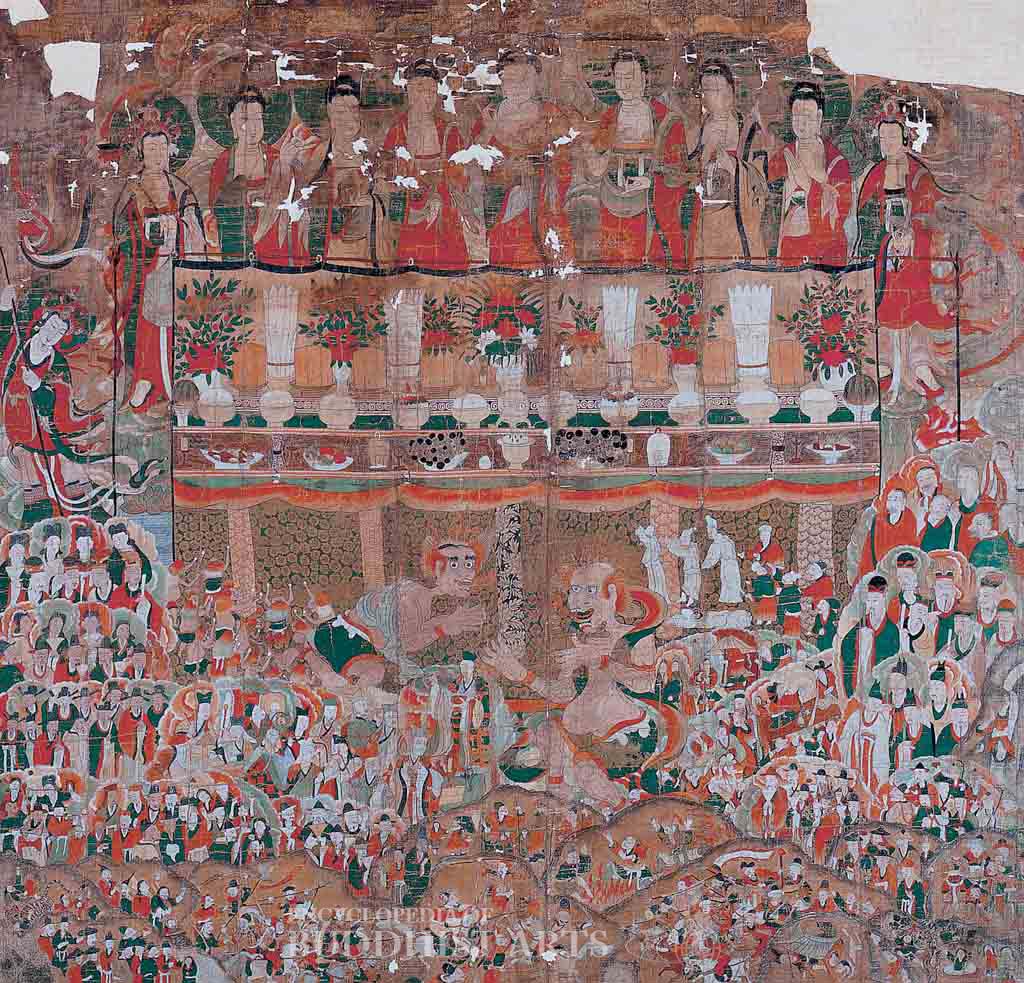
Boseoksa Temple: Illustration of the Ullambana Sutra
Ink and color on linen
Boseoksa Temple: Illustration of the Ullambana Sutra
SOUTH KOREA, South Chungcheong, Geumsan; Joseon dynasty
In the Ullambana Sutra, the Buddha gives instructions on how to ease the suffering of beings in the lower realms by making ceremonial food offerings. In this gamro (sweet dew) artwork, a unique kind of Korean Buddhist painting, the offering ceremony is depicted along with images of Buddhas, Bodhisattvas, monastics, and a battle.
The Seven Buddhas of the Past, Avalokitesvara, and Mahasthamaprapta Bodhisattva stand in the upper register above a large hanging banner meant to symbolize the ceremonial offerings. The banner is decorated with an image of an altar. On the lower row of the altar there is an incense burner, candles, and offerings of grapes, watermelon, cake, a vessel full of sweet dew, and bowls of rice. Memorial tablets and flowers are painted above the offerings. The altar cloth is decorated with intricate floral patterns. Below the banner, two large hungry ghosts with thin necks and wild expressions spit flames from their mouths. On the left, more hungry ghosts climb up the banner, trying to reach the symbolic offerings. A Bodhisattva as a Guide stands on the far left. Large groups of monastics and devotees are shown beside the bottom corners of the banner conducting a Dharma service.
The lower register of the illustration portrays an army of volunteer soldiers and monastics fighting in the battle of Chingju during the Japanese invasions of Korea (1592–1598). After the war, a Dharma service to liberate the deceased was held at Boseoksa Temple. This painting could be a symbolic representation of that service.
For more details, go to the Encyclopedia of Buddhist Arts: Painting A-H, page 118.
Cite this article:
author = Hsingyun and Youheng and Youlu and Wilson, Graham and Manho and Mankuang and Huntington, Susan,
booktitle = {Encyclopedia of Buddhist Arts: Painting A-H},
pages = 118,
title = {{Boseoksa Temple: Illustration of the Ullambana Sutra}},
volume = 14,
year = {2016}}