
Nisonin Temple: Master Honen
Ink and color on silk
Nisonin Temple: Master Honen
JAPAN, Kyoto; Kamakura period
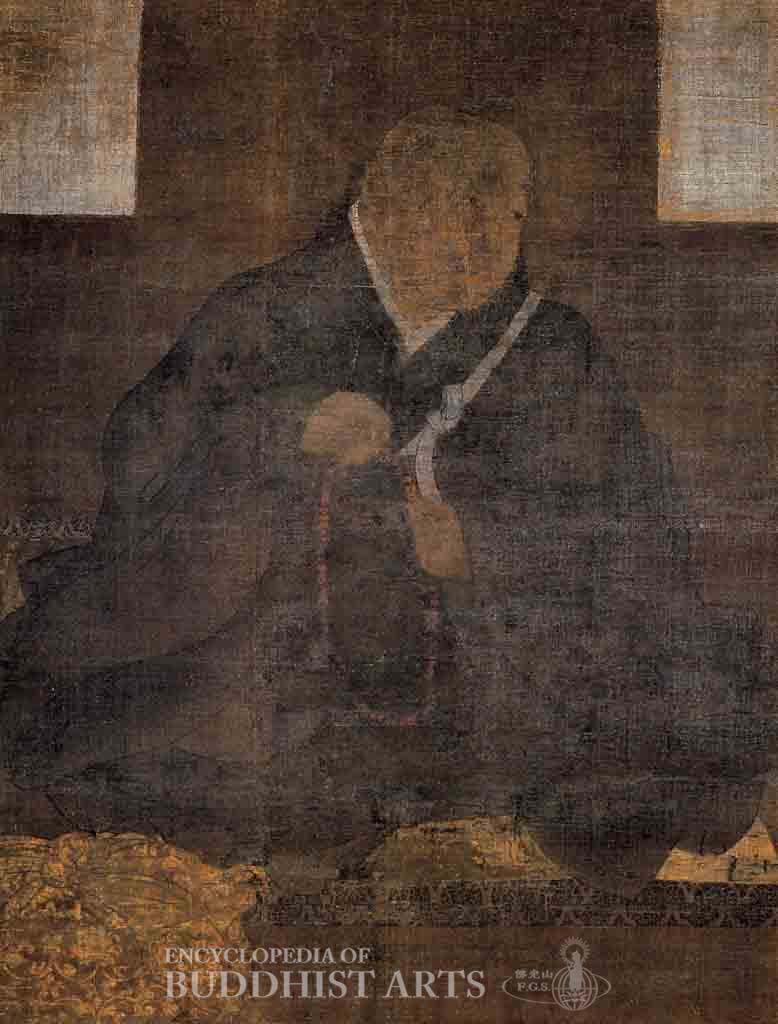
Known in Japan as the “Ashibiki no Miei,” this 13th century painting is the earliest known portrait of the eminent Master Honen, the founder of the Japanese Pure Land school. In 1939, it was listed as an Important Cultural Property. According to historical records, Honen did not allow his disciples to paint his image. The artist Takuma Hogen was asked to discreetly paint Honen as he relaxed and stretched his legs after a bath. As soon as Honen realized what was happening, he immediately covered his feet.
Honen wears a black monastic robe and holds prayer beads in his hands. He sits looking off to one side with a calm, gentle gaze. Admirers of this artwork thought that this expression perfectly captured Honen’s spirit, and it was imitated in later portraits. Inscriptions within cartouches occupy the upper corners, and in the lower left corner, there is a cloth sack.
For more details, go to the Encyclopedia of Buddhist Arts: Painting I-O, page 713.
Cite this article:
author = Hsingyun and Youheng and Youlu and Wilson, Graham and Manho and Mankuang and Huntington, Susan,
booktitle = {Encyclopedia of Buddhist Arts: Painting I-O},
pages = 713,
title = {{Nisonin Temple: Master Honen}},
volume = 15,
year = {2016}}