
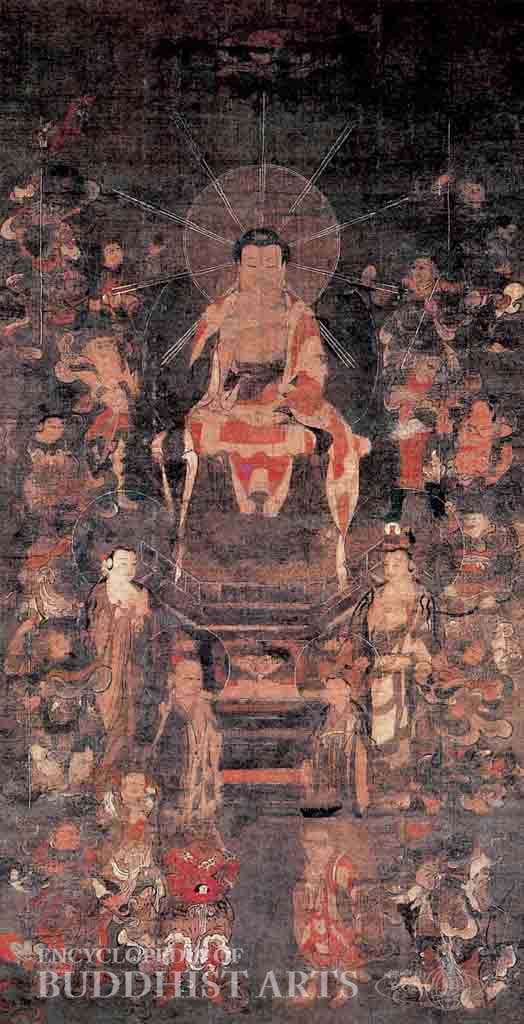
Onjoji Temple: Sakyamuni Buddha Assembly
Ink and color on silk
Onjoji Temple: Sakyamuni Buddha Assembly
JAPAN, Shiga, Otsu; Kamakura period
Meant to be displayed during ceremonial recitations of the Mahaprajnaparamita Sutra, this painting dates from the 13th century and was listed as an Important Cultural Property of Japan in 1908.
Sakyamuni Buddha sits on a tall lotus throne and wears a patched monastic robe. Golden beams of light radiate from the Buddha’s head. Manjusri and Samantabhadra Bodhisattvas, Mahadevi, and Mahakasyapa stand below the throne. Master Xuanzang, the great Tang dynasty (618–907) Buddhist monk who brought the Mahaprajnaparamita Sutra back to China from India, is shown in the center of the lower register beside his guardian, General Shensha. Imposing Dharma protectors are painted along the sides of the picture. According to the Dharani Samuccaya Sutra, Dharma protectors watch over the Mahaprajnaparamita Sutra and those who recite it.
The symmetrically arranged figures are meticulously drawn with detailed expressions. Contrast is created by using bright colors and gold highlights on a dark background. In similar paintings associated with the Mahaprajnaparamita Sutra from the late Heian (794–1185) and early Kamakura (1185–1333) periods, the central Buddha figure was accompanied by two disciples, Brahma, Sakra and sixteen deities, or by sixteen deities and four Bodhisattvas. The inclusion of Xuanzang and General Shensha became popular during the late Kamakura period.
For more details, go to the Encyclopedia of Buddhist Arts: Painting I-O, page 724.
Cite this article:
author = Hsingyun and Youheng and Youlu and Wilson, Graham and Manho and Mankuang and Huntington, Susan,
booktitle = {Encyclopedia of Buddhist Arts: Painting I-O},
pages = 724,
title = {{Onjoji Temple: Sakyamuni Buddha Assembly}},
volume = 15,
year = {2016}}