
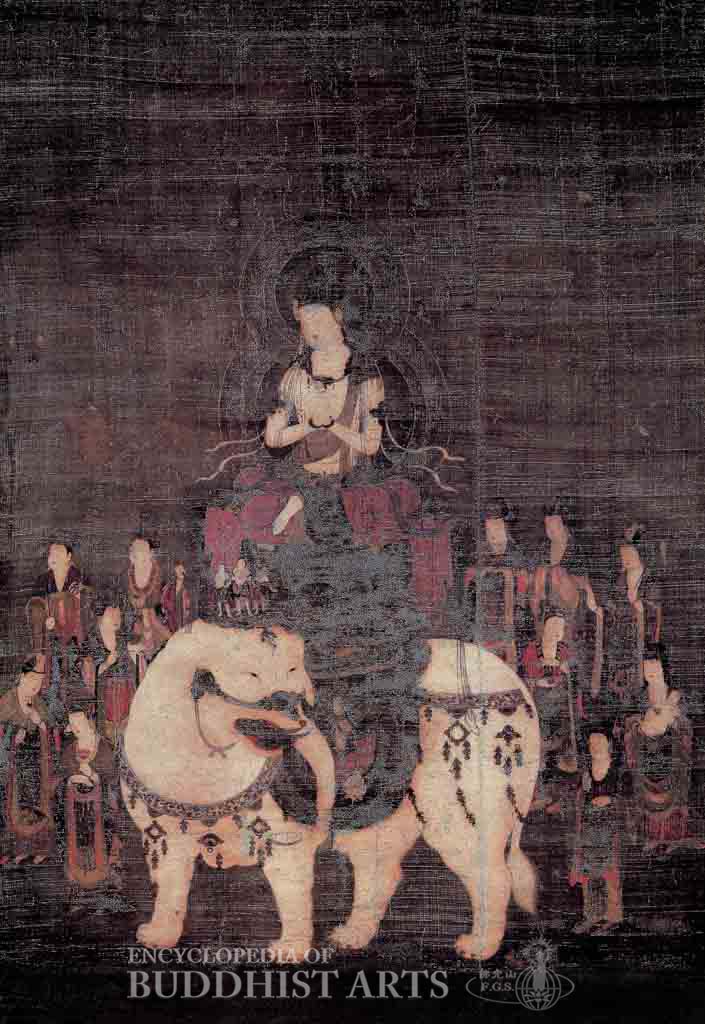
Rozanji Temple: Samantabhadra Bodhisattva and Ten Raksasis
Ink and color on silk
Rozanji Temple: Samantabhadra Bodhisattva and Ten Raksasis
JAPAN, Kyoto; Heian period
During the late Heian period (794–1185), noblewomen created illustrations of Samantabhadra Bodhisattva and ten raksasis as blessings for deceased relatives and prayers for a favorable rebirth. In this 12th century painting, the ten female raksasis are dressed in Chinese clothing, suggesting that this is one of the earliest versions of such artworks. The painting was listed as an Important Cultural Property in 1960.
Samantabhadra sits on a lotus throne on the back of a white elephant. Three small figures stand on the elephant’s head. The ten raksasis are painted behind the Bodhisattva, each striking a slightly different pose. Hariti stands on the right, holding a child. Silver and gold threads are used to depict the folds in their robes. The dark background and bright highlights are characteristic of Heian art.
For more details, go to the Encyclopedia of Buddhist Arts: Painting P-Z, page 772.
Cite this article:
author = Hsingyun and Youheng and Youlu and Wilson, Graham and Manho and Mankuang and Huntington, Susan,
booktitle = {Encyclopedia of Buddhist Arts: Painting P-Z},
pages = 772,
title = {{Rozanji Temple: Samantabhadra Bodhisattva and Ten Raksasis}},
volume = 16,
year = {2016}}