
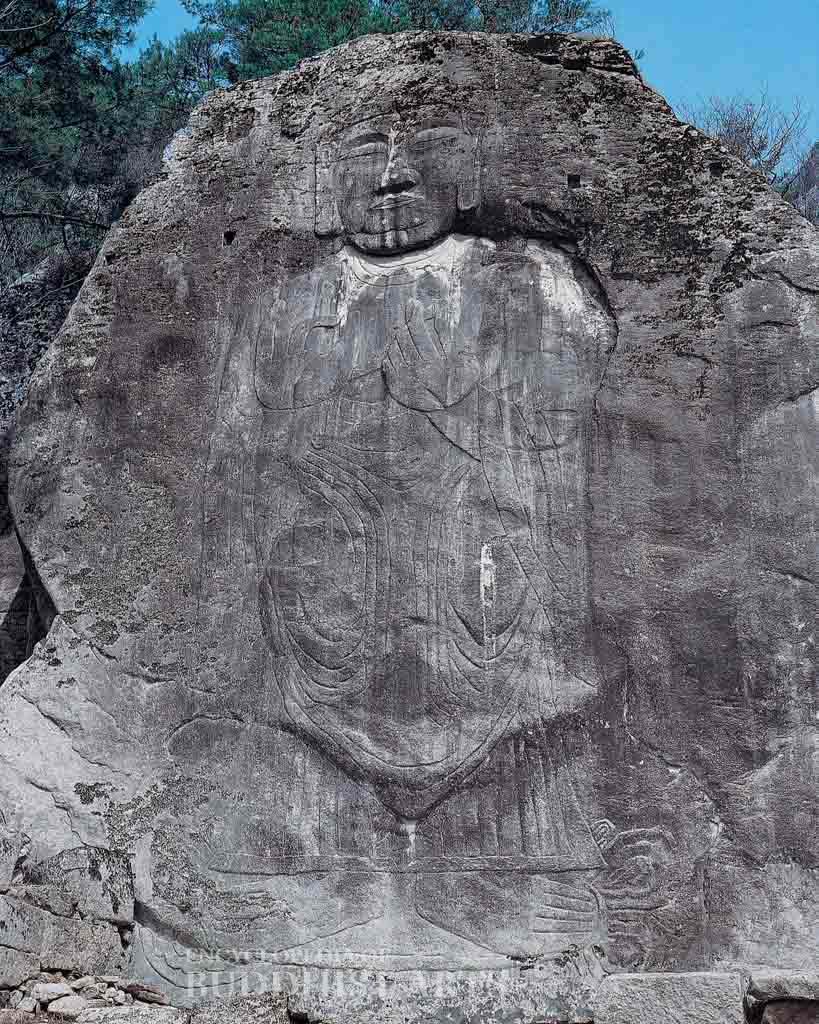
Deokyusa Temple: Standing Buddha
Stone
Deokyusa Temple: Standing Buddha
SOUTH KOREA, North Chungcheong, Jecheon; Goryeo dynasty
Located on the southern face of a granite cliff, this carving of the Buddha and the foundation below it are all that remain of Deokyusa Temple. It is thought to date from the 11th century, reflecting the popularity of large Buddha sculptures during the early Goryeo dynasty (918–1392). The carving was listed as Treasure No. 406 in 1964.
The head is sculpted in bas-relief. A natural protusion of the rock is used to suggest the Buddha’s hair. The Buddha has a rounded face and exaggerated features. As the head is very close to the torso, the triple fold usually seen on the neck of most Buddha images has been incised on the chest instead. The parallel lines depicting the folds of the monastic robe and the concentric oval lines about the thighs are in the style of the Unified Silla dynasty (668–935). The hands are held in front of the chest, with the thumb and middle finger of each touching, suggesting that the figure is Amitabha Buddha. The oversized feet rest on a pedestal and point outwards. Two square holes above the shoulders suggest the former presence of a wooden structure.
For more details, go to the Encyclopedia of Buddhist Arts: Caves A-E, page 304.
Cite this article:
author = Hsingyun and Youheng and Johnson, Peter and Mankuang and Huntington, Susan and Edson, Gary and Neather, Robert,
booktitle = {Encyclopedia of Buddhist Arts: Caves A-E},
pages = 304,
title = {{Deokyusa Temple: Standing Buddha}},
volume = 5,
year = {2016}}