
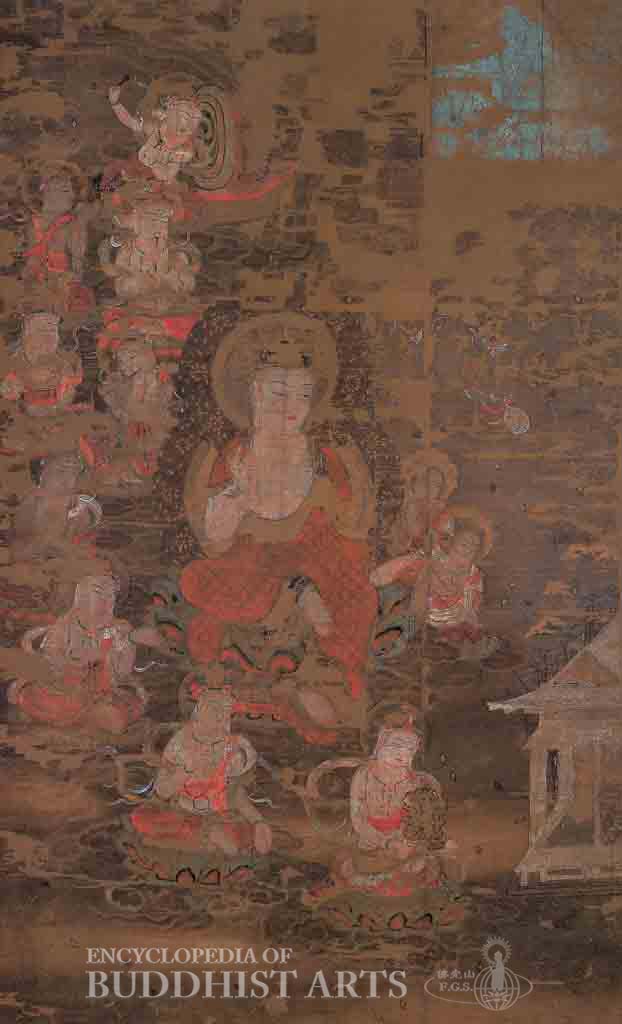
Jogonin Temple: Amitabha Buddha and Bodhisattvas Welcoming the Deceased
Ink and color on silk
Jogonin Temple: Amitabha Buddha and Bodhisattvas Welcoming the Deceased
JAPAN, Shiga, Gamo; Heian period
This 12th century hanging scroll is one of the oldest surviving Japanese raigo (welcoming approach) paintings that depict Amitabha and a retinue of Bodhisattvas descending upon clouds to welcome a deceased being to the Pure Land. An inscription on the original hanging rod states that the painting was restored in 1546 and 1724. It was listed as an Important Cultural Property in 1997.
Amitabha Buddha, the largest figure in the painting, wears a red monastic robe and displays a mudra different from that seen in most other raigo paintings. At the bottom of the picture, Avalokitesvara kneels beside a building, holding out a gold lotus throne for the deceased. Mahasthamaprapta, shown on the lower left, here does not join palms, as is customarily seen in other similar works. Manjusri, holding a scripture, and Samantabhadra, with joined palms, are shown on the left beside Amitabha. On the right, Ksitigarbha and Nagarjuna are portrayed as monks. Five Bodhisattvas playing musical instruments sit in the upper left corner.
For more details, go to the Encyclopedia of Buddhist Arts: Painting I-O, page 393.
Cite this article:
author = Hsingyun and Youheng and Youlu and Wilson, Graham and Manho and Mankuang and Huntington, Susan,
booktitle = {Encyclopedia of Buddhist Arts: Painting I-O},
pages = 393,
title = {{Jogonin Temple: Amitabha Buddha and Bodhisattvas Welcoming the Deceased}},
volume = 15,
year = {2016}}