
Kaijusenji Temple: Illustration of the Lotus Sutra
Ink and color on silk
Kaijusenji Temple: Illustration of the Lotus Sutra (detail)
Kaijusenji Temple: Illustration of the Lotus Sutra
JAPAN, Kyoto; Heian to Kamakura period
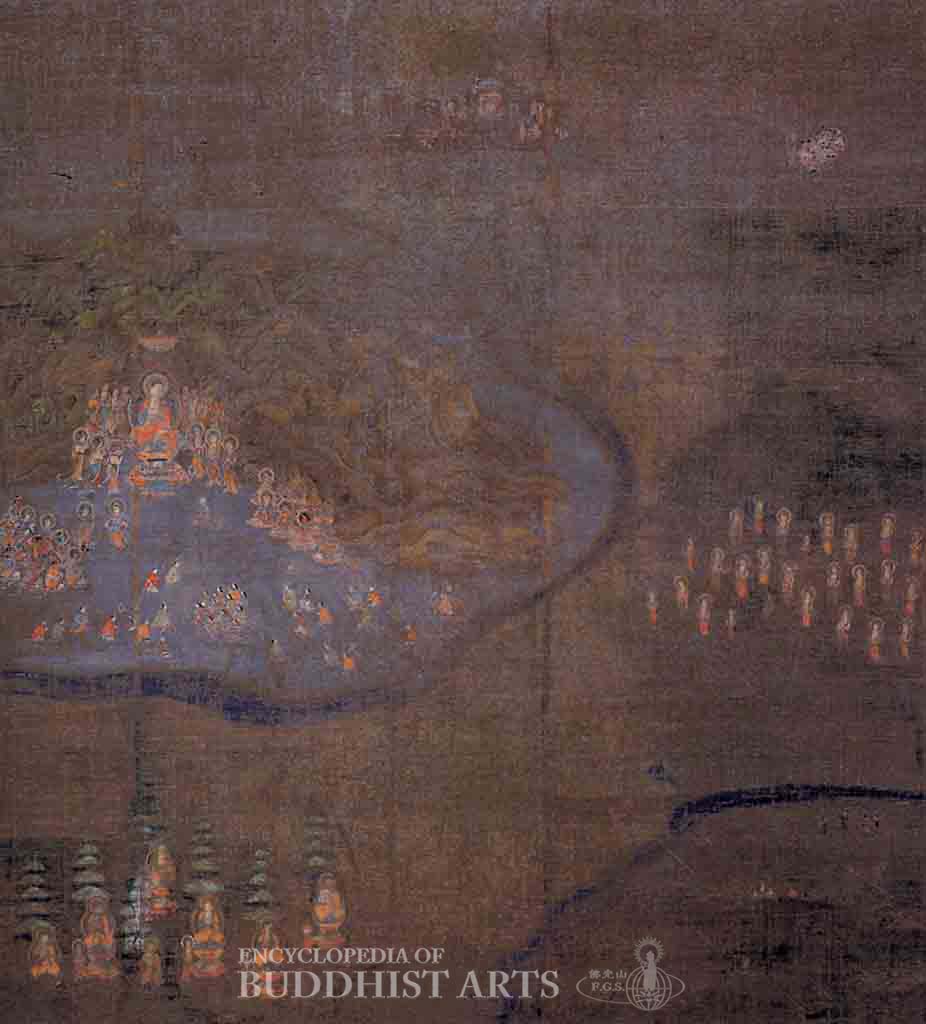
The Lotus Sutra was popular in Japan during the Heian (794–1185) and Kamakura (1185–1333) periods. This painting is thought to have been created by monks of Kaijusenji Temple, who were devoted to the study of the sutra. The painting incorporates scenes from five chapters of the sutra, and is listed as an Important Cultural Property of Japan.
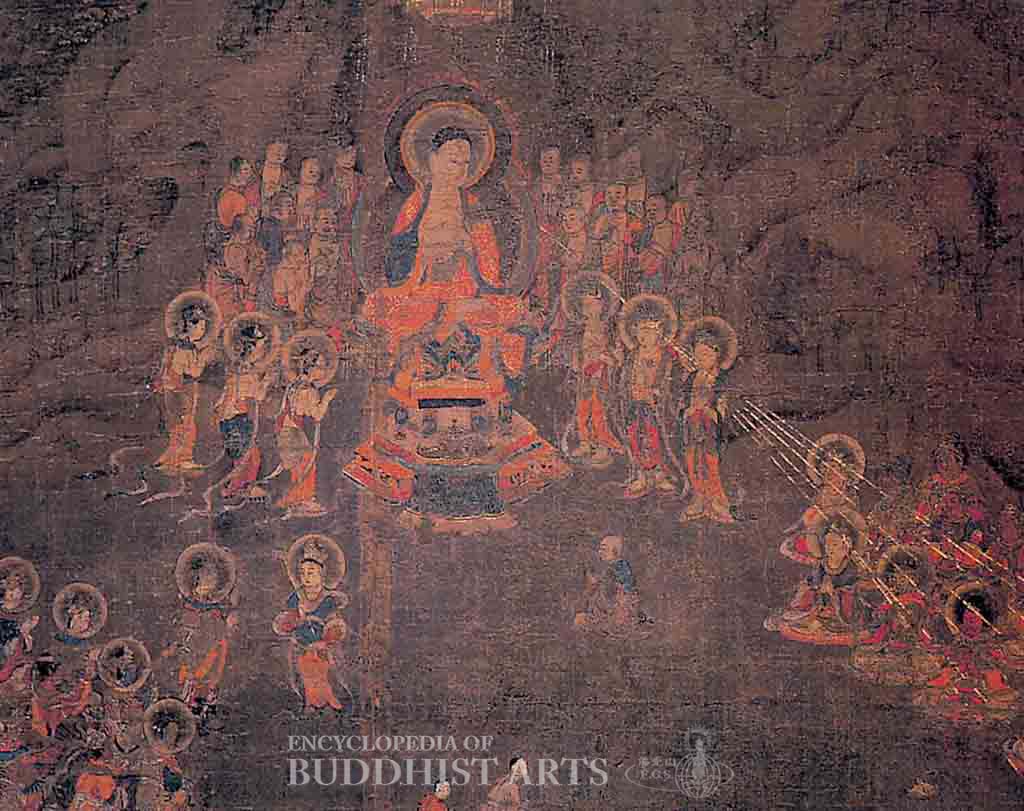
A scene from the “Introductory Chapter” depicting the Buddha on Vulture Peak giving the teaching that would become the Lotus Sutra takes up a large section in the middle of the left hand side of the painting. Seated in full lotus position on a lotus throne, the Buddha emits rays of light from his brow that extend across the picture, lighting up the eastern land and the underground hells. The Buddha is surrounded by monks, Arhats, heavenly beings, and lay disciples listening to the Dharma.
A scene from the “Chapter on the Emergence of the Prabhutaratna Pagoda,” is painted in the center of the upper register. Sakyamuni and Prabhutaratna Buddhas are depicted sitting side-by-side in a pagoda. The “Chapter on Gadgadasvara Bodhisattva” is portrayed on the upper right. On the right side of the middle register, Bodhisattvas emerge from the ground, a scene from the “Chapter on Emerging from the Earth.” On the left hand side of the bottom register there is an image from the “Chapter on Supernatural Powers of the Tathagata,” with the Buddha seated on a lion throne under the shade of a tree. The small size of the figures and the sparse landscape of hills, sandbanks, and forests on a largely undecorated background emphasizes the vastness of the Buddha Land.
For more details, go to the Encyclopedia of Buddhist Arts: Painting I-O, page 408.
Cite this article:
author = Hsingyun and Youheng and Youlu and Wilson, Graham and Manho and Mankuang and Huntington, Susan,
booktitle = {Encyclopedia of Buddhist Arts: Painting I-O},
pages = 408,
title = {{Kaijusenji Temple: Illustration of the Lotus Sutra}},
volume = 15,
year = {2016}}