
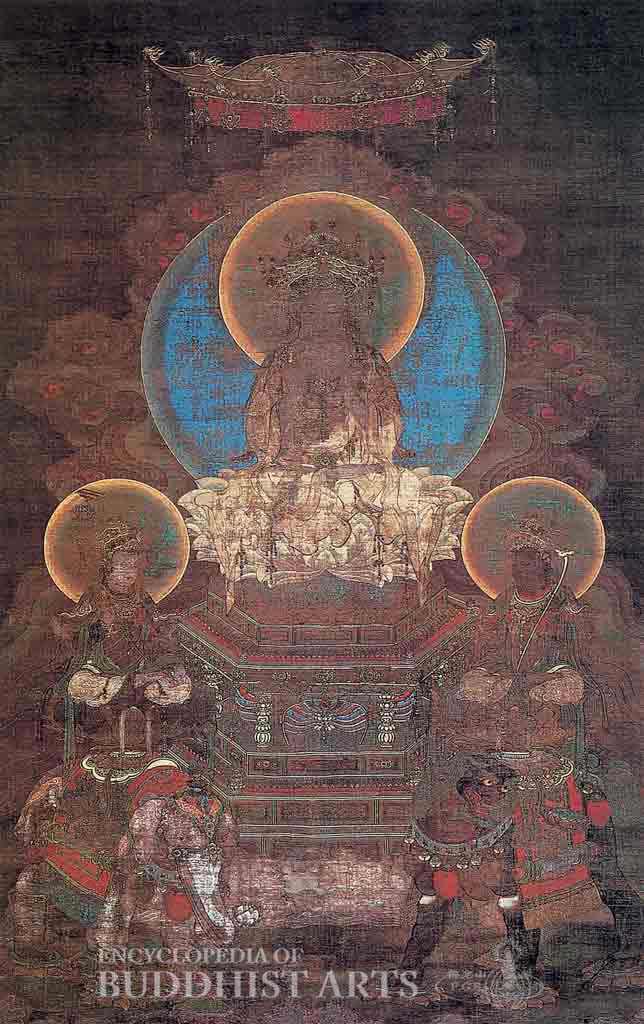
Sakyamuni Buddha Triad
Ink and color on silk
Sakyamuni Buddha Triad
CHINA; Southern Song dynasty
This is a well-known Southern Song dynasty (1127–1279) painting of Sakyamuni Buddha flanked by Manjusri and Samantabhadra Bodhisattvas. Thought to have been produced by an artist from a monastery, it features more advanced painting techniques than most other Song dynasty images. In 1899, it was listed as an Important Cultural Property of Japan. The central figure, Sakyamuni Buddha, is dressed in a white robe, wears a crown decorated with a Buddha image, and forms murdras in front of his chest with both hands. The Buddha, with a yellow nimbus and a blue mandorla surrounded by clouds, is seated on a white lotus throne supported on a hexagonal Sumeru platform with a canopy overhead. To the right of the throne, Manjusri Bodhisattva, with a ruyi (wish-fulfilling talisman) in hand, sits on a lotus throne atop a lion. Samantabhadra Bodhisattva, holding a lotus, is mounted on a six-tusked white elephant on the left side of the picture.
For more details, go to the Encyclopedia of Buddhist Arts: Painting P-Z, page 787.
Cite this article:
author = Hsingyun and Youheng and Youlu and Wilson, Graham and Manho and Mankuang and Huntington, Susan,
booktitle = {Encyclopedia of Buddhist Arts: Painting P-Z},
pages = 787,
title = {{Sakyamuni Buddha Triad}},
volume = 16,
year = {2016}}