
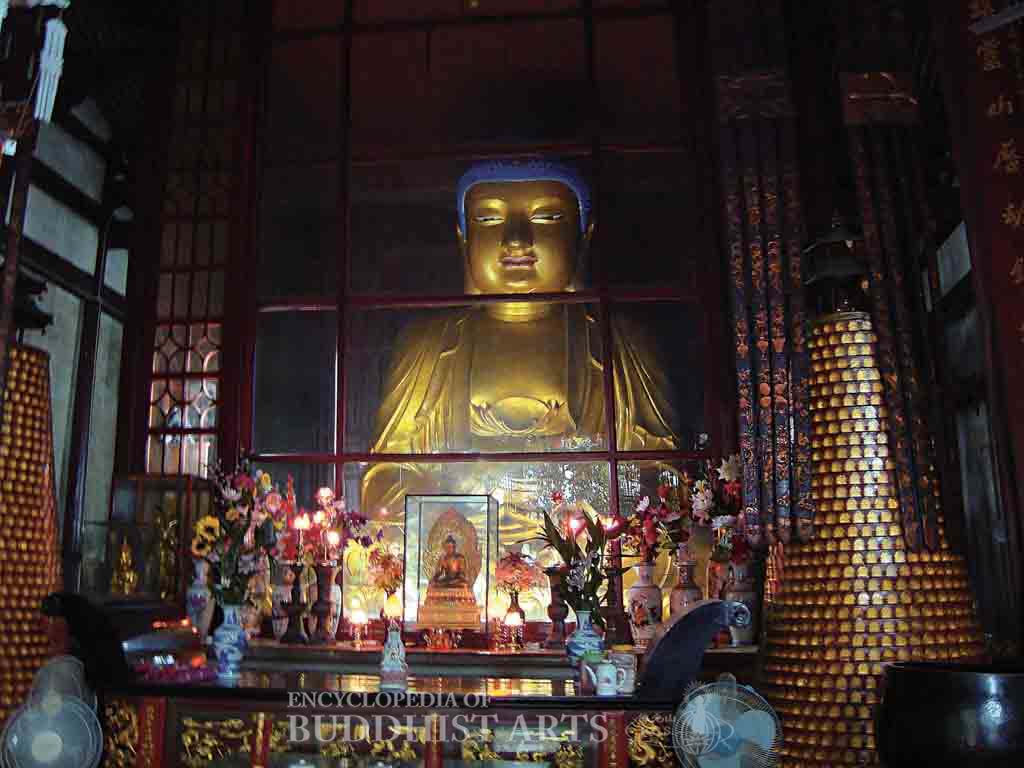
Kaiyuan Temple Iron Buddha Hall: Amitabha Buddha
Iron
Kaiyuan Temple Iron Buddha Hall: Amitabha Buddha
CHINA, Fujian, Fuzhou; Northern Song dynasty
Research reveals that the statue was metal cast and then gilded. It weighs around 52 t and is one of the heaviest metal Buddhas in China. Various accounts ascribe its origin to either the 10th or 11th century. However, when the building housing it was renovated in 1659, a silver pagoda was discovered hidden beneath the statue’s throne, the inscription dates it to 1083. From this, experts believe it was created during 1078 to 1085 of the Northern Song dynasty (960–1127). The statue was listed as a Provincial Cultural Heritage Property in 1991.
The Buddha wears an elaborately folded monastic robe over both shoulders and sits on a lotus throne, in full lotus position with hands in the dhyana (meditation) mudra.
For more details, go to the Encyclopedia of Buddhist Arts: Sculpture G-M, page 516.
Cite this article:
author = Hsingyun and Youheng and Lovelock, Yann and Chou, Yuan and Huntington, Susan and Edson, Gary and Neather, Robert,
booktitle = {Encyclopedia of Buddhist Arts: Sculpture G-M},
pages = 516,
title = {{Kaiyuan Temple Iron Buddha Hall: Amitabha Buddha}},
volume = 11,
year = {2016}}