
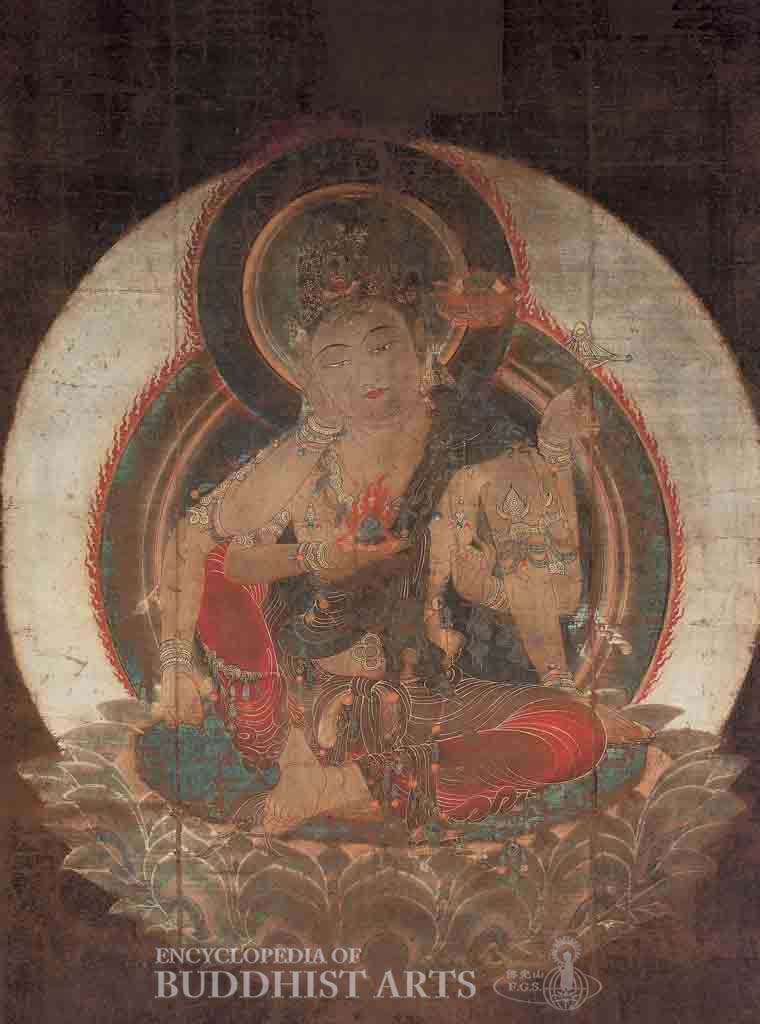
Hozoji Temple: Cintamanicakra Avalokitesvara
Ink and color on silk
Hozoji Temple: Cintamanicakra Avalokitesvara
JAPAN, Shiga, Koka; Kamakura period
This painting, listed as an Important Cultural Property in 1900, depicts Cintamanicakra, a form of Avalokitesvara Bodhisattva. According to the Cintamanicakra Avalokitesvara Yoga, Cintamanicakra has a golden body with six arms, and sits in royal ease posture holding a wish-fulfilling jewel. The painting builds upon this description. Cintamanicakra wears a tall headdress with a Buddha image in the center. The body is adorned with a golden necklace, bracelets, and armlets. The Bodhisattva sits on a lotus throne with the right arms resting on the raised right knee. One of the right hands supports the head, while the other two hold a wish-fulfilling jewel and prayer beads. The upper left hand holds up the Mountain of Bright Light, and the two other left hands hold a long-stemmed lotus and a treasure wheel.
The nimbus and aureole are decorated with flame patterns, and are surrounded by a white mandorla. Fine gold lines are used to depict the folds of the dhoti. The petals of the lotus throne are lightly shaded to give a sense of depth. Although this image was painted during the early Kamakura period (1185–1333), it has the dark, solemn appearance of Heian period (794–1185) artworks.
For more details, go to the Encyclopedia of Buddhist Arts: Painting A-H, page 344.
Cite this article:
author = Hsingyun and Youheng and Youlu and Wilson, Graham and Manho and Mankuang and Huntington, Susan,
booktitle = {Encyclopedia of Buddhist Arts: Painting A-H},
pages = 344,
title = {{Hozoji Temple: Cintamanicakra Avalokitesvara}},
volume = 14,
year = {2016}}