
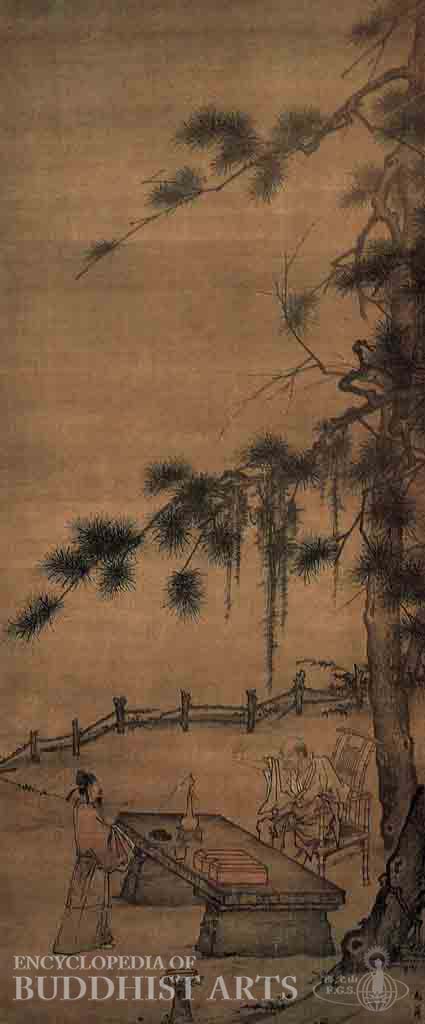
Meeting Between Yaoshan and Li Ao
Ink and color on silk
Meeting Between Yaoshan and Li Ao
CHINA; Southern Song dynasty
This depiction of a Chan story was painted during the Southern Song dynasty (1127–1279). Chan stories were common subjects for artworks during the Song (960–1279) and Yuan (1271–1368) dynasties. The seal of Ma Gongxian is affixed to the painting. Little is known about the life of this artist. He was the son of Ma Xingzu, the uncle of Ma Yuan, and a member of the Imperial Art Academy during the Southern Song dynasty. Ma Gongxian was skilled at painting flowers, birds, landscapes, and portraits. Unfortunately, most of his artworks have been lost. This rare painting is listed as an Important Cultural Property of Japan.
According to the Transmission of the Lamp, magistrate Li Ao once visited Master Yaoshan, who was reading a sutra and did not pay attention to his guest. Li Ao, who had heard that the master was wise and had been eager to meet him, became impatient, and told Master Yaoshan, “It was better to hear your name than to see your face.” Yaoshan asked, “Why do you prefer what you hear to what you see?” The governor appreciated this answer, and inquired about the path to enlightenment. Master Yaoshan pointed to the sky, then to a vase, but the governor did not understand, so Yaoshan said, “The cloud is in the sky; the water is in the vase.” Li Ao gladly thanked the master for this teaching. Later, Li composed a Buddhist poem: “Train till the body resembles the shape of a crane. Two chests of sutras under thousands of pine trees. I asked about the path, then not much talk remained; the cloud in the sky and the water in the vase.”
Chan masters are able to enlighten disciples with surprising, unorthodox statements. Chan paintings attempt to visually represent this spontaneous wisdom. Yaoshan sits on a bamboo chair beneath a tall pine tree. He leans forward with one hand pointed up and the other down, indicating that the cloud is in the sky and the water is in the vase. In front of Yaoshan, chests containing Buddhist sutras and a vase holding a bare branch rest on a stone table. Li Ao stands on the other side of the table, dressed in the robes of an official. The needles of the pine tree, the figures, and the folds in their robes are painted with sharp, fine lines.
For more details, go to the Encyclopedia of Buddhist Arts: Painting I-O, page 529.
Cite this article:
author = Hsingyun and Youheng and Youlu and Wilson, Graham and Manho and Mankuang and Huntington, Susan,
booktitle = {Encyclopedia of Buddhist Arts: Painting I-O},
pages = 529,
title = {{Meeting Between Yaoshan and Li Ao}},
volume = 15,
year = {2016}}