
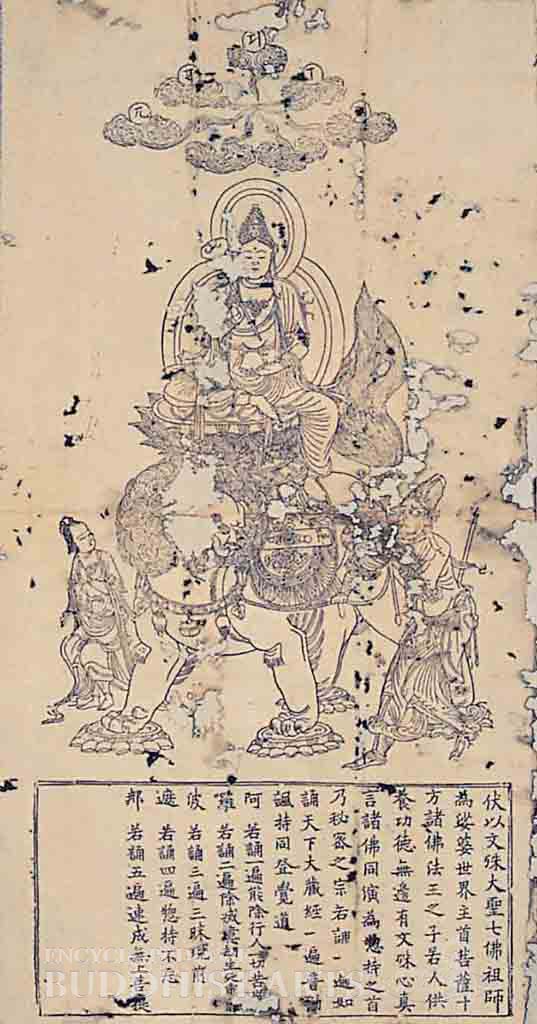
Manjusri and Samantabhadra Bodhisattvas - Manjusri
Print on paper
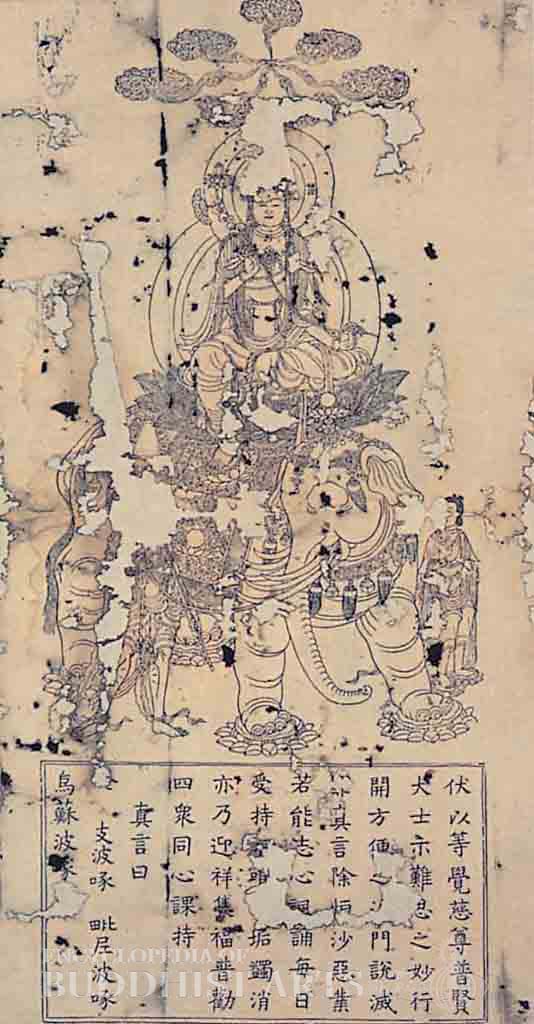
Manjusri and Samantabhadra Bodhisattvas - Samantabhadra
Manjusri and Samantabhadra Bodhisattvas
CHINA; Northern Song dynasty
These woodblock prints were made during the Northern Song dynasty (960–1127), and were collected by the Japanese monk Chonen of Todaiji Temple during his stay at Kaiyuan Temple in China in 985. They are listed as a National Treasure of Japan.
Parts of the prints have torn away, but the images are mostly intact. Manjusri Bodhisattva, with the right leg tucked against the body and the left foot resting on a lotus pedestal, is seated on a lotus throne on the back of a lion with a curled mane. The Bodhisattva holds a ruyi (wish-fulfilling talisman) with both hands. The nimbus and the aureole are depicted with three black lines. Uniquely shaped clouds that support circles containing Chinese characters hover above the head of the Bodhisattva. On the right beside the lion, a keeper wearing a tall hat leans forward, holding a rope that is attached to the beast’s neck. On the left, a young attendant joins palms in reverence.
Samantabhadra Bodhisattva, holding a long-stemmed lotus with both hands, is seated in a manner similar to Manjusri. The nimbus, the aureole, and the cluster of clouds above the Bodhisattva are also similar, but there are no Chinese characters in this image. The lotus throne rests on the back of an elephant with six tusks. On the right beside the elephant, a female figure with joined palms looks up at the Bodhisattva. A mahout stands in front of the elephant holding a rope. Below both Bodhisattvas, their vows and mantras are written in neatly carved Chinese characters.
For more details, go to the Encyclopedia of Buddhist Arts: Painting I-O, page 509.
Cite this article:
author = Hsingyun and Youheng and Youlu and Wilson, Graham and Manho and Mankuang and Huntington, Susan,
booktitle = {Encyclopedia of Buddhist Arts: Painting I-O},
pages = 509,
title = {{Manjusri and Samantabhadra Bodhisattvas}},
volume = 15,
year = {2016}}