
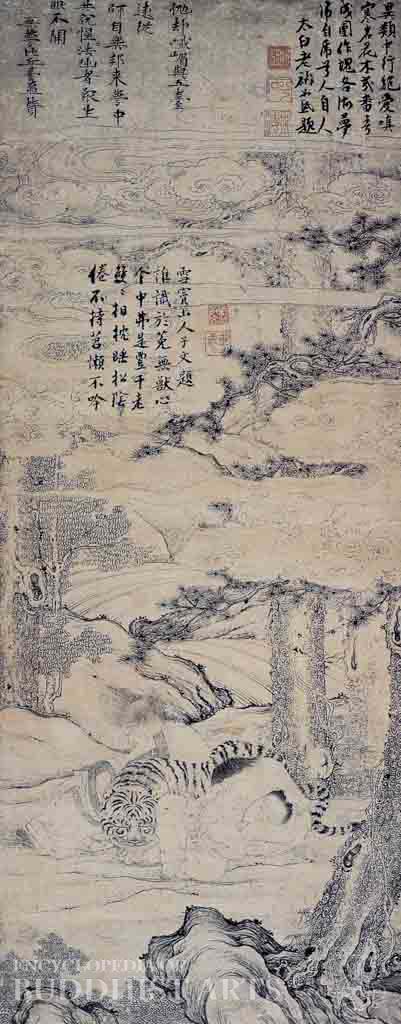
Four Sleepers
Ink on paper
Four Sleepers
CHINA; Yuan dynasty
In this Yuan dynasty painting, Fenggan, Hanshan, Shide, and a tiger are depicted sleeping soundly together. There are several verses about these four sleeping figures in the Buddhist poetry of the Southern Song dynasty (1127–1279). In The Recorded Sayings of the Qiaoyin Monk there is a verse reading: “Humans and a tiger as a group, what kind of companions are these! Their hearts and faces are different, their minds ever changing. When wind shakes the pine door, it is late spring.” In the Recorded Sayings of Chan Master Dahui Pujue, it is written that “Fenggan, Shide and Hanshan lean against the furless old tiger, sleeping soundly together, unaware that the moon is high above the mountains.” Also, in the Recorded Sayings of Chan Master Fojian, it states that “The good may not be good, the evil may not be evil; if they cannot forget each other, how can they sleep? It is hard for evil to be good, it is hard for good to be evil; the tiger forgets the difference, so how could it not sleep?” There are inscriptions on this painting by Pingshi Rudi, Mengtang Tan’e, and Huaguo Ziwen. Based on the dates of the inscriptions, this painting was created before 1351. In 1982, it was listed as an Important Cultural Property of Japan.
During the Song dynasty (960–1279), artists painted in three distinct styles, each with different features and a unique appearance: the Academy style, the Literati style, and the Chan style. After the Yuan dynasty (1271–1368), these three styles started to mix and borrow from one another. The line drawing techniques of the Literati style are used in this picture to express a Chan theme. The trees, the clouds, and the fur of the tiger are beautifully detailed.
For more details, go to the Encyclopedia of Buddhist Arts: Painting A-H, page 257.
Cite this article:
author = Hsingyun and Youheng and Youlu and Wilson, Graham and Manho and Mankuang and Huntington, Susan,
booktitle = {Encyclopedia of Buddhist Arts: Painting A-H},
pages = 257,
title = {{Four Sleepers}},
volume = 14,
year = {2016}}