
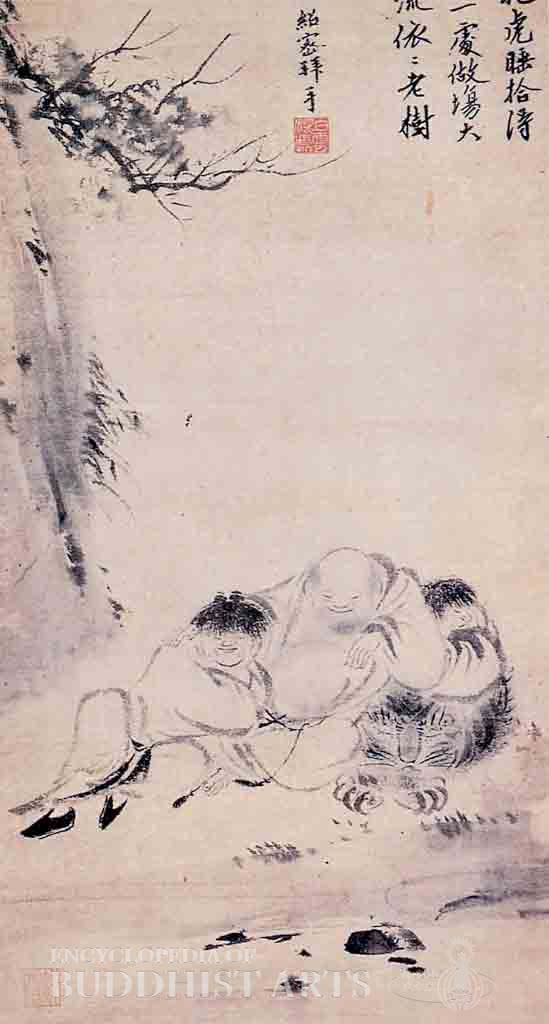
Four Sleepers
Ink on paper
Four Sleepers
CHINA; Yuan dynasty
Fenggan, Hanshan, Shide, and a tiger, all sleeping soundly, are depicted in this Zen painting. This is a common image in Song dynasty (960–1279) and Yuan dynasty (1271–1368) artworks. According to the Song Biographies of Eminent Monks, Fenggan, a monk at Guoqing Temple on Tiantaishan, often rode a tiger, and was a friend of Hanshan, a reclusive poet who lived in a cave on the mountain. Fenggan found Shide when he was a small child, abandoned in the mountains, and brought him to Guoqing Temple. He worked in the kitchen and would save the scraps of the monk’s meals for Hanshan.
Master Xiangfu of the Yuan dynasty inscribed his praise on the picture at the behest of the emperor, and also impressed his collector’s seal. Praise rendered in Buddhist verses was commonly added to paintings during the Southern Song dynasty. This inscription emphasizes the harmony of the four figures sleeping in a pile, and of the humans and tiger coexisting. This painting brings to mind two other Buddhist verses. The Yuejian Monk Verses state, “Tiger and human lean together and forget who they really are, but their minds awaken. Being friends and curling up asleep, who could care about the world and time?” The Rujing Monk Verses contain this passage: “Shide, Hanshan, Fenggan, and a tiger, endlessly sleeping without reason. Hey! Their wise eyes open suddenly, many monsters were concealed.” There is a seal reading “Monan” in the lower register. Monan was a Japanese Zen painter who lived during the Kamakura period. He went to China to study in 1330, and eventually died there, but his works were brought back to Japan and were later listed as Important Cultural Properties.
In the painting, Shide, Hanshan, Fenggan, and the tiger curled up sleeping in a heap together, each with a peaceful and contented expression. The faces of the figures are depicted with simple, thin lines. There is a wash of light ink on the face and belly of Fenggan. Dark ink is used for the hair, belts, and shoes of the figures. The rock wall in the background is painted with diluted ink.
For more details, go to the Encyclopedia of Buddhist Arts: Painting A-H, page 258.
Cite this article:
author = Hsingyun and Youheng and Youlu and Wilson, Graham and Manho and Mankuang and Huntington, Susan,
booktitle = {Encyclopedia of Buddhist Arts: Painting A-H},
pages = 258,
title = {{Four Sleepers}},
volume = 14,
year = {2016}}