
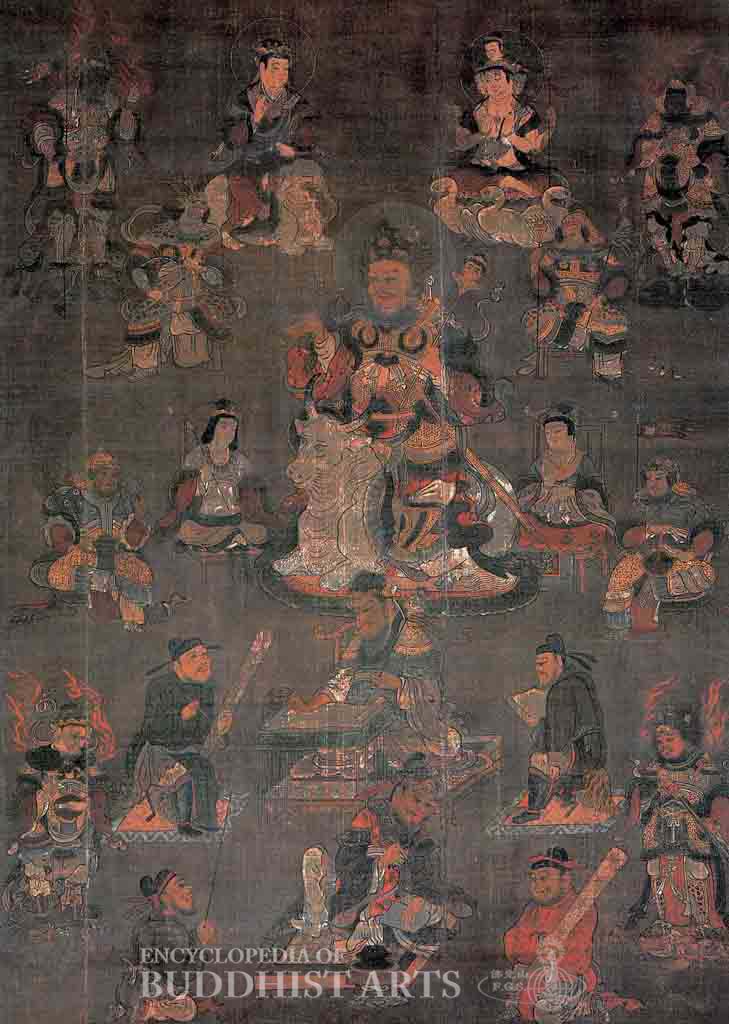
Onjoji Temple: Yama
Ink and color on silk
Onjoji Temple: Yama
JAPAN, Shiga, Otsu; Kamakura period
In the Anthology of Asaba, this picture is referred to as the “Mandala of Nineteen Figures.” Painted in the 13th century, it was used in Tendai rituals to cast away diseases, avert disasters, and bestow blessings. In 1900, the picture was listed as an Important Cultural Property.
Yama is in the center of the painting, sitting on the back of a white ox. He has wide eyes, red lips, a beard, and long hair that stands up beside his head. Dressed in golden armor, Yama holds the head-topped staff in his left hand and raises his right hand with the palm facing upwards. Two consorts sit in chairs beside the ox. The remaining figures include the Four Heavenly Kings and other heavenly beings.
For more details, go to the Encyclopedia of Buddhist Arts: Painting I-O, page 725.
Cite this article:
author = Hsingyun and Youheng and Youlu and Wilson, Graham and Manho and Mankuang and Huntington, Susan,
booktitle = {Encyclopedia of Buddhist Arts: Painting I-O},
pages = 725,
title = {{Onjoji Temple: Yama}},
volume = 15,
year = {2016}}