
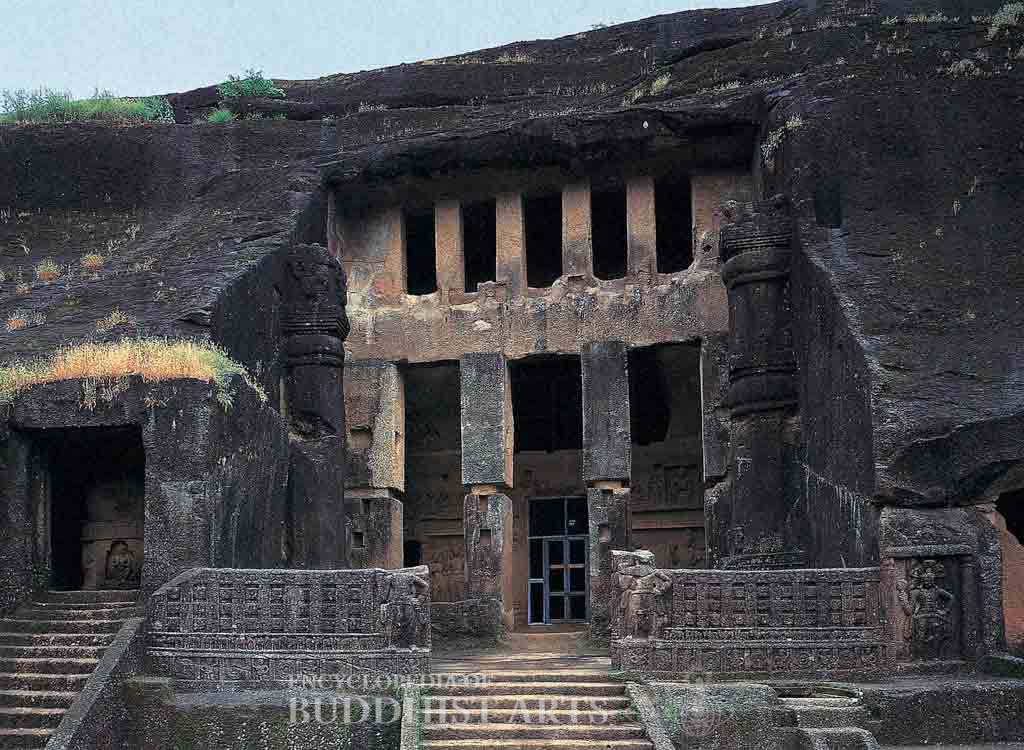
Kanheri Caves
Kanheri Caves
INDIA, Maharashtra, Mumbai
These caves are located 20 km north of Mumbai within Sanjay Gandhi National Park. They consist of over 110 caves on hilly terrain composed of volcanic rock and were constructed over an extended period of time, the earliest dating to the 3rd century BCE. The caves originally served as rest stops for merchants and travelers, and later became centers for Buddhist cultivation. By the 3rd century CE, Kanheri became an important Buddhist site on the west coast of India and some of the caves were occupied up to the 9th century.
The most impressive among the early caves is Cave 3, which contains inscriptions dating to the late 2nd century during the Satavahana period (circa 200 BCE–250 CE). The layout is similar to that of the caitya cave at the Karla Caves. There is a courtyard with stairs and balustrades, leading up to the portico with high columns. A standing Buddha carved on the lower section of the right portico column is the only Buddha image found in the earlier caves and provides firm evidence of the introduction of Buddha images to Western India during that time. On each side of the entrance are carvings of mithuna couples. The large standing Buddhas carved on the side walls and in the niches above the door are later additions, dated to the 6th century. The interior of Cave 3 is 13.7 m wide and 12.9 m high, with a depth of 26.4 m. There are a total of 34 columns which form a corridor around the hall. The central part of the main hall has a barrel-vaulted ceiling, while that of the corridor is flat. At the rear is a stupa with a damaged finial. There are a variety of carvings on the capitals of the columns, including mithuna couples riding animals, an elephant spurting water, and the Buddha’s footprints under the Bodhi tree.
The caves that were created between 6th and the 9th centuries are smaller in size and without much architectural adornment. It is worth noting that reliefs with Vajrayana Buddhist themes can be found. For example, the Buddha Triad in Cave 41 includes an Eleven-Headed, Four-Armed Avalokitesvara, an image rarely seen in India, and in Cave 90 is a relief of the Buddha Teaching the Dharma, which includes a multitude of Buddhas and Bodhisattvas arranged in the layout of a mandala. These sculptures are indicative of the developments which occurred during the later stages of Buddhism in India.
For more details, go to the Encyclopedia of Buddhist Arts: Caves R-L, page 452.
Cite this article:
author = Hsingyun and Youheng and Johnson, Peter and Mankuang and Huntington, Susan and Edson, Gary and Neather, Robert,
booktitle = {Encyclopedia of Buddhist Arts: Caves R-L},
pages = 452,
title = {{Kanheri Caves}},
volume = 6,
year = {2016}}