
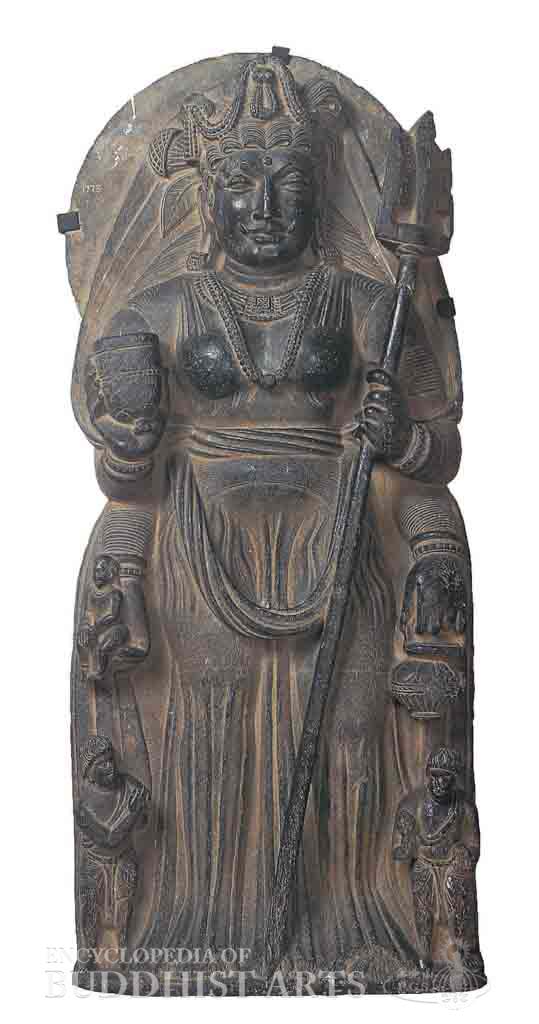
Sahri Bahlol: Hariti
Schist
Sahri Bahlol: Hariti
PAKISTAN, Khyber Pakhtunkhwa, Peshawar
The statue, when discovered, was initially identified as Shiva by the archaeologist Aurel Stein due to the presence of the trident and the figure’s upward pointing fangs. Experts later concluded that the sculpture represented Hariti, a demoness who devoured children. She was eventually taken into Buddhism as a compassionate goddess and a protector of children.
Hariti’s well-rounded figure is portrayed with four arms holding, a cup and a child, and a trident and a vase. A lion’s head with a string of beads in its mouth is on the figure’s headdress, with more beads arranged over Hariti’s curled hair. An urna is visible on the forehead. Hariti holds a kind expression despite the presence of fangs in the mouth. A pair of large tubular earrings and an assortment of heavy jewelry decorate the figure. A belt is fastened at the waist, from which a stole hangs across the lap. The folds of the figure’s skirt are used to delineate the shape of the legs. Two smaller figures are located on either side at Hariti’s feet, one paying homage and the other making an offering.
For more details, go to the Encyclopedia of Buddhist Arts: Sculpture N-Sr, page 888.
Cite this article:
author = Hsingyun and Youheng and Lovelock, Yann and Chou, Yuan and Huntington, Susan and Edson, Gary and Neather, Robert,
booktitle = {Encyclopedia of Buddhist Arts: Sculpture N-Sr},
pages = 888,
title = {{Sahri Bahlol: Hariti}},
volume = 12,
year = {2016}}