
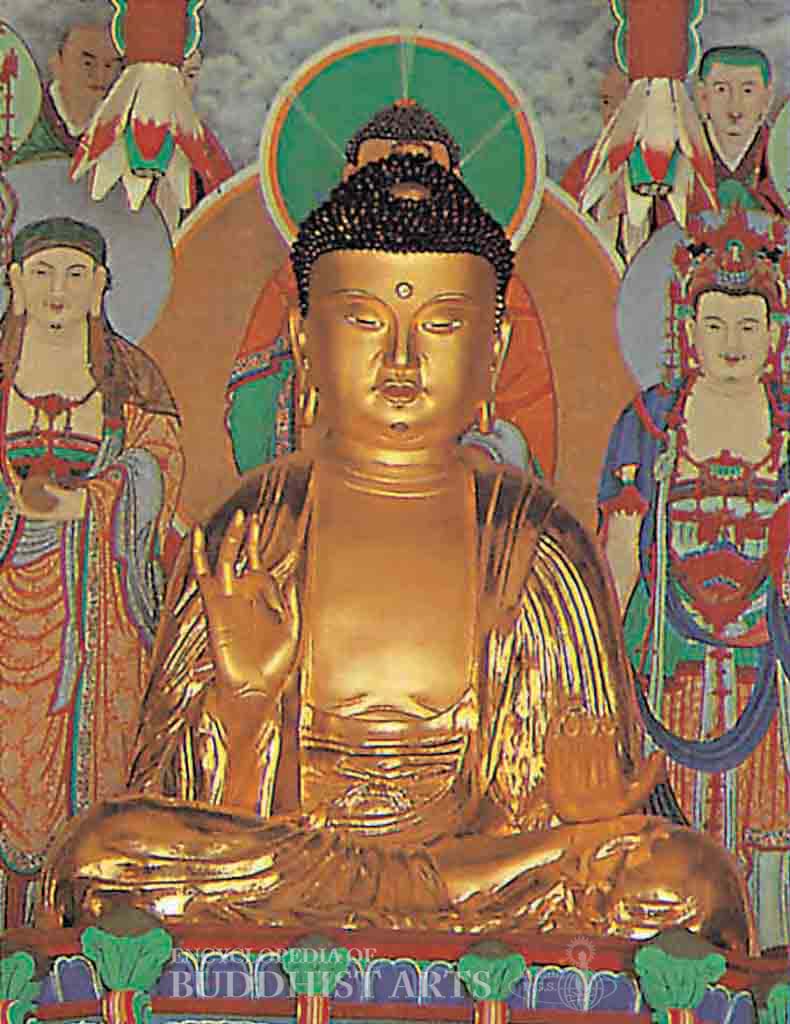
Simhyangsa Temple: Seated Buddha
Dry lacquer
Simhyangsa Temple: Seated Buddha
SOUTH KOREA, South Jeolla, Naju; Goryeo dynasty
The statue, found in Simhyangsa Temple, was created using the dry lacquer technique, with the clay core removed. Artifacts were found within the statue that tentatively dates it to the end of the Goryeo dynasty (918–1392). There is also an inscription on the base. It was listed as Treasure No. 1544 in 2008.
The Buddha sits in full lotus position with the right hand raised in lotus mudra, and the other hand resting on the knee with the fingers upturned. A monastic robe that is opened at the front to reveal an inner garment, covers both shoulders. There is a crest jewel at the top of the usnisa and another at its base where the hair begins.
For more details, go to the Encyclopedia of Buddhist Arts: Sculpture N-Sr, page 1100.
Cite this article:
Hsingyun, et al. "Simhyangsa Temple: Seated Buddha." Encyclopedia of Buddhist Arts: Sculpture N-Sr, vol. 12, 2016, pp. 1100.
Hsingyun, Youheng, Yann Lovelock, Yuan Chou, Susan Huntington, Gary Edson, and Robert Neather. 2016. "Simhyangsa Temple: Seated Buddha" In Encyclopedia of Buddhist Arts: Sculpture N-Sr, 12:1100.
Hsingyun, Youheng, Lovelock, Y., Chou, Y., Huntington, S., Edson, G., & Neather, R.. (2016). Simhyangsa Temple: Seated Buddha. In Encyclopedia of Buddhist Arts: Sculpture N-Sr (Vol. 12, pp. 1100).
@misc{Hsingyun2016,
author = Hsingyun and Youheng and Lovelock, Yann and Chou, Yuan and Huntington, Susan and Edson, Gary and Neather, Robert,
booktitle = {Encyclopedia of Buddhist Arts: Sculpture N-Sr},
pages = 1100,
title = {{Simhyangsa Temple: Seated Buddha}},
volume = 12,
year = {2016}}
author = Hsingyun and Youheng and Lovelock, Yann and Chou, Yuan and Huntington, Susan and Edson, Gary and Neather, Robert,
booktitle = {Encyclopedia of Buddhist Arts: Sculpture N-Sr},
pages = 1100,
title = {{Simhyangsa Temple: Seated Buddha}},
volume = 12,
year = {2016}}