
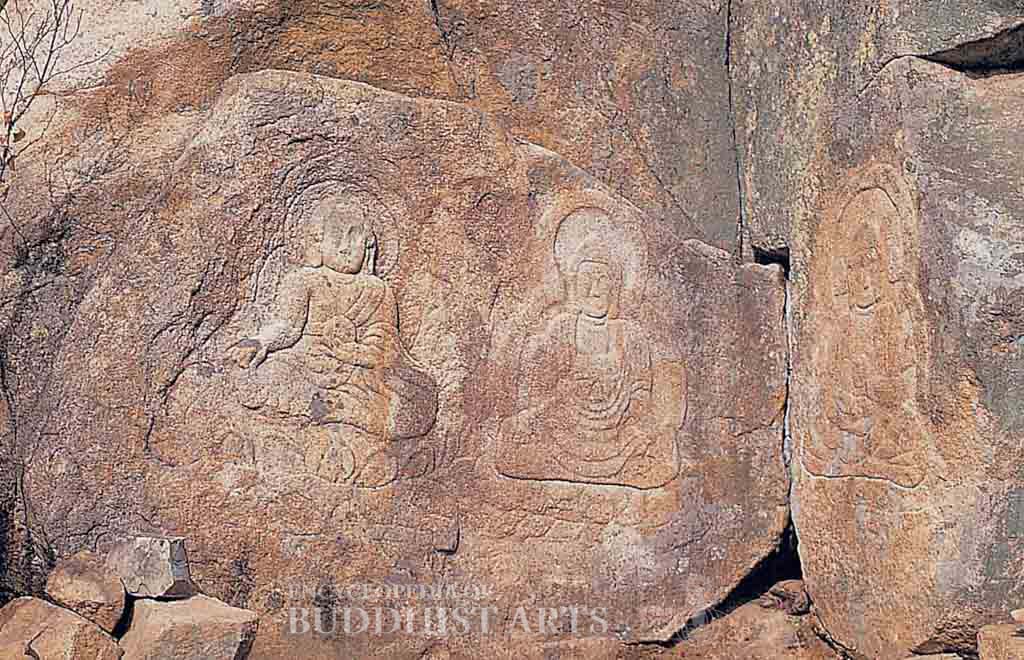
Yunulkol Valley Rock Carvings
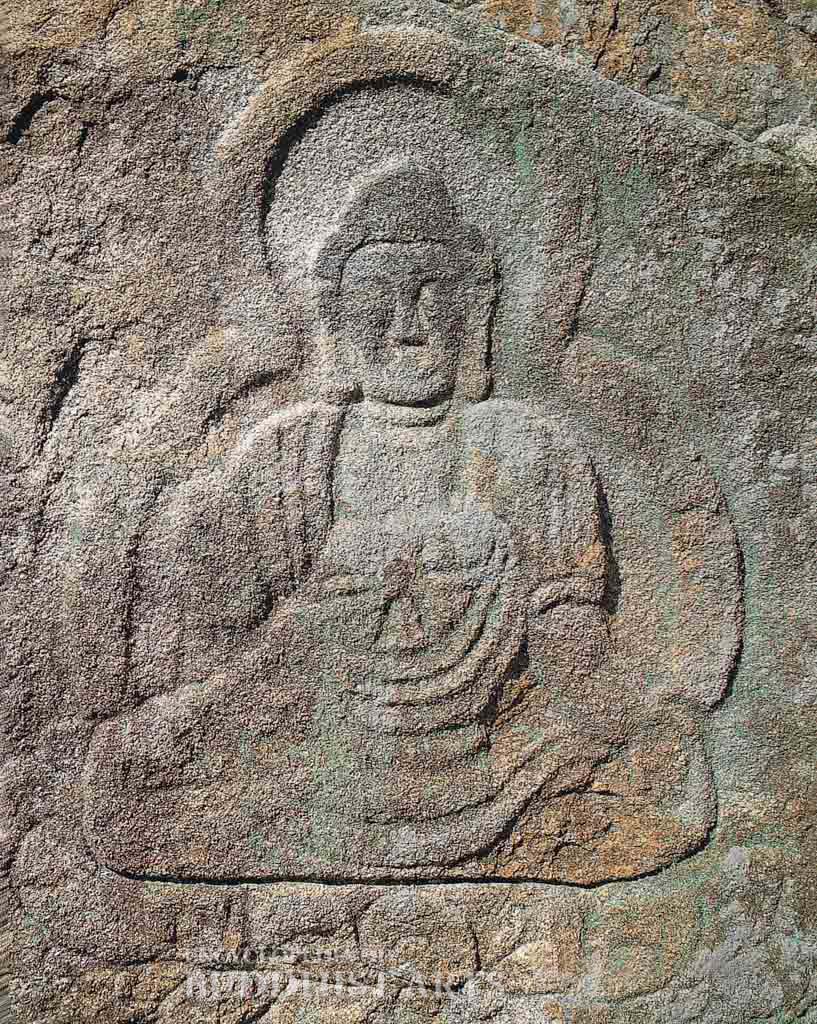
Yunulkol Valley Rock Carvings (center)
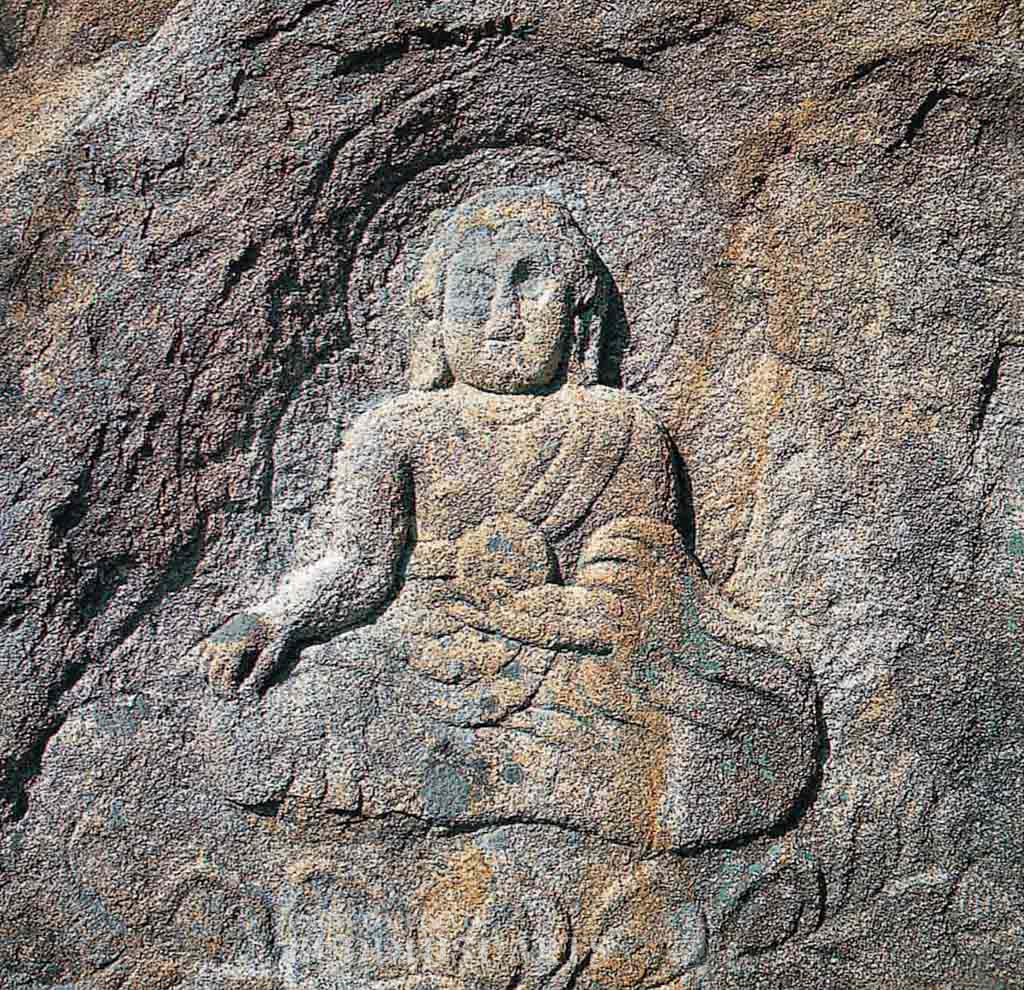
Yunulkol Valley Rock Carvings (left side)
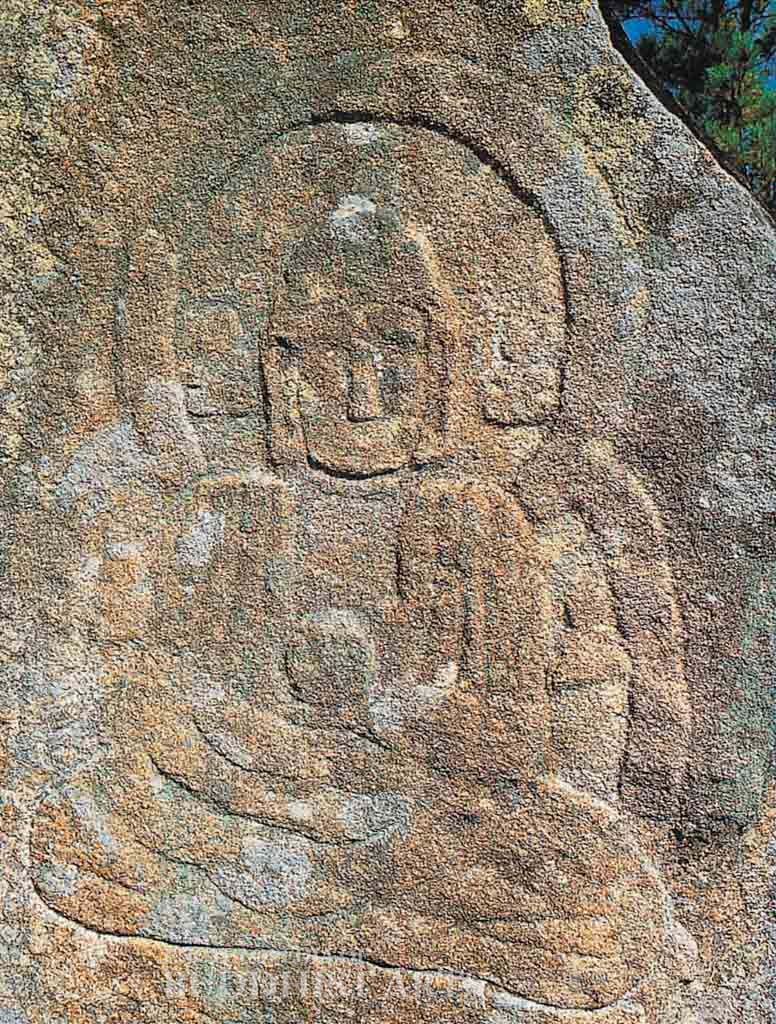
Yunulkol Valley Rock Carvings (right side)
Yunulkol Valley Rock Carvings
SOUTH KOREA, North Gyeongsang, Gyeongju
Three seated Buddhas are carved in low relief on the cliff wall. Two of these face southeast, while the third faces southwest. Their composition, proportion, posture, and artistic style are typical of sculptures from the 8th to late 9th century. They are thought to represent the Three Buddhas: Medicine Buddha, Sakyamuni Buddha, and Maitreya Buddha. This is the only such grouping carved during the Silla period (57 BCE–935CE). The rock carvings are listed as Provincial Tangible Cultural Property No. 195.
The figure in the center sits upon a lotus throne. The shoulders are slightly high, as was popular in 9th century statues. The folds of the garment have wide curves. The damaged right hand was probably raised in the abhaya (fearlessness) mudra while the left hand forms the bhumisparsa (earth-touching) mudra. The Buddha is framed inside an interlocking aureole and nimbus, to the right of which is an inscription indicating the year 835.
The statue to the left is slightly smaller and wears a robe that bares the right shoulder. The right hand rests on the knee with fingers slightly bent while the left, holding a medicine bowl, identifies the figure as the Medicine Buddha. The aureole and nimbus intersect behind him.
The carving juxtaposed on the right side is more simply executed. The left hand also holds a medicine bowl with the right hand beneath it. On each side of the aureole and nimbus is a seated Buddha image.
For more details, go to the Encyclopedia of Buddhist Arts: Caves T-Z, page 1749.
Cite this article:
author = Hsingyun and Youheng and Johnson, Peter and Mankuang and Huntington, Susan and Edson, Gary and Neather, Robert,
booktitle = {Encyclopedia of Buddhist Arts: Caves T-Z},
pages = 1749,
title = {{Yunulkol Valley Rock Carvings}},
volume = 9,
year = {2016}}