
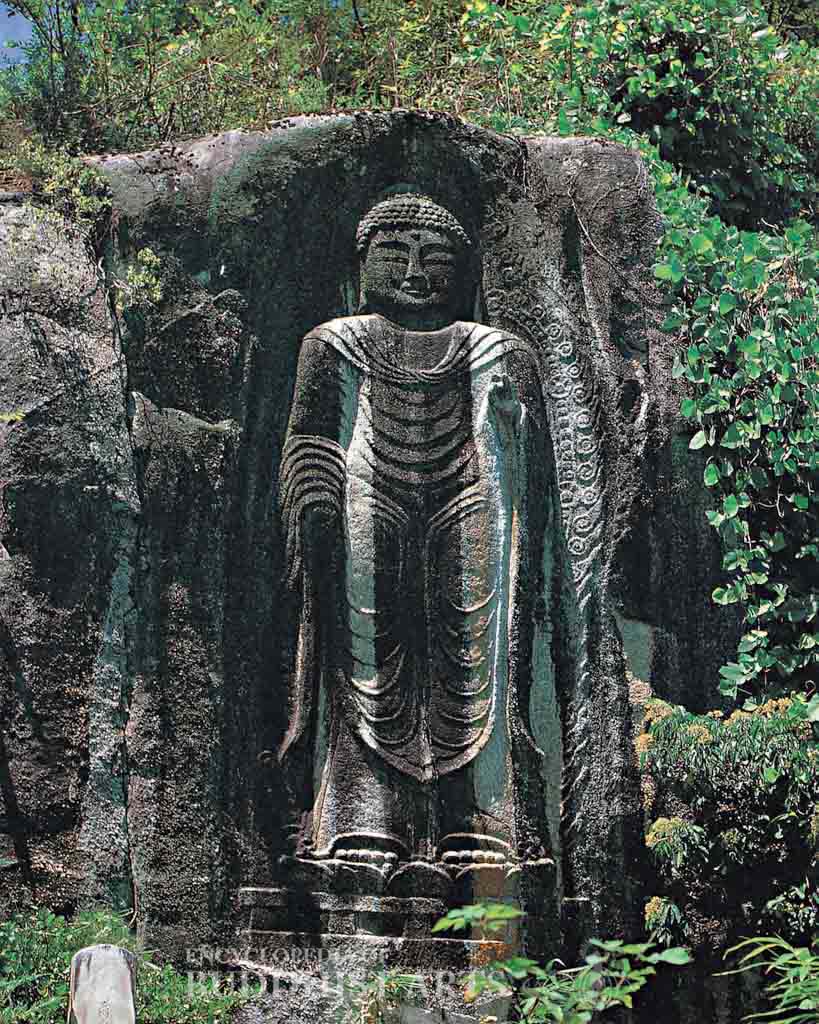
Macheonmyeon: Standing Buddha
Stone
Macheonmyeon: Standing Buddha
SOUTH KOREA, South Gyeongsang, Hamyang; Goryeo dynasty
This large standing Buddha in high relief is representative of statues from the Goryeo period (918–1392). The statue was listed as Treasure No. 375 in 1963.
The rock from which the Buddha was carved is cut back to form a niche. The edge of the niche, shaped to form a curving mandorla, encloses a flame-patterned aureole and circular nimbus. The shapes of the nose and the tightly closed mouth are similar to the standing Buddha in Yangpyeongdong, Geochang, created in the late Unified Silla dynasty (668–935). The figure, with broad shoulders covered in a monastic robe, stands on a lotus pedestal. The collar makes a complete turn at the chest, a style that originated in India and was later brought to Korea via China. The robe ripples downwards in folds that then divide over the thighs.
For more details, go to the Encyclopedia of Buddhist Arts: Caves M-Mo, page 727.
Cite this article:
author = Hsingyun and Youheng and Johnson, Peter and Mankuang and Huntington, Susan and Edson, Gary and Neather, Robert,
booktitle = {Encyclopedia of Buddhist Arts: Caves M-Mo},
pages = 727,
title = {{Macheonmyeon: Standing Buddha}},
volume = 7,
year = {2016}}