
Cheongyang: Buddha Triad
Granite
Cheongyang: Buddha Triad
Cheongyang: Buddha Triad
SOUTH KOREA, South Chungcheong, Cheongyang; Goryeo dynasty
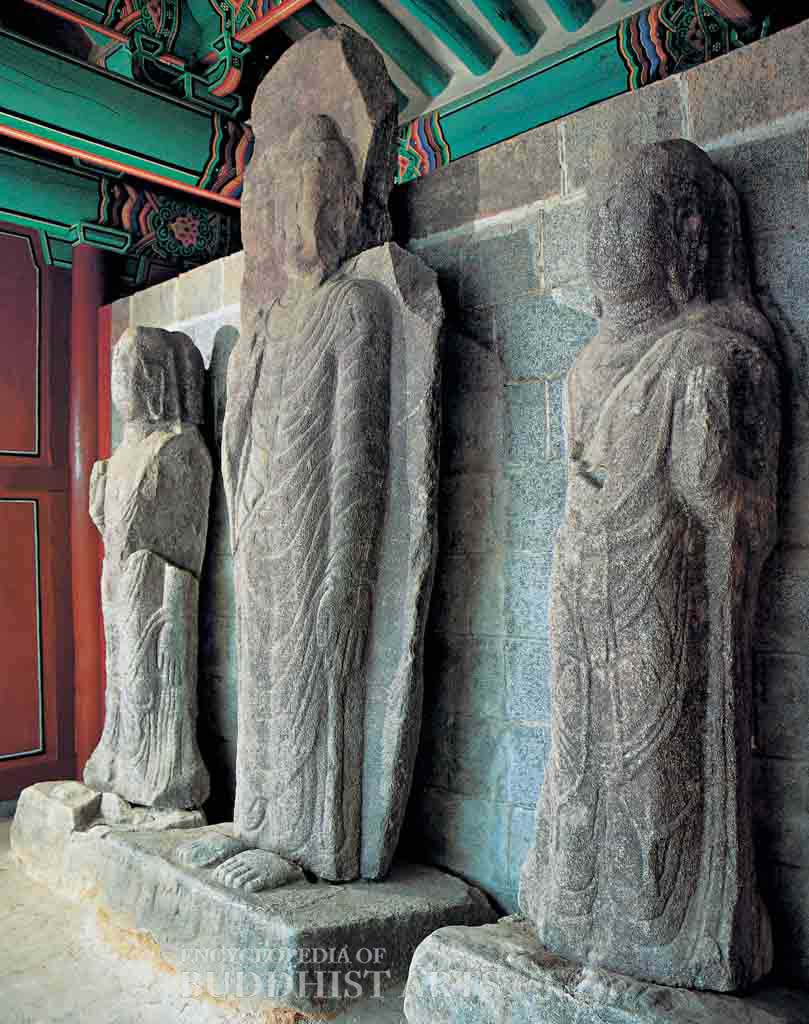
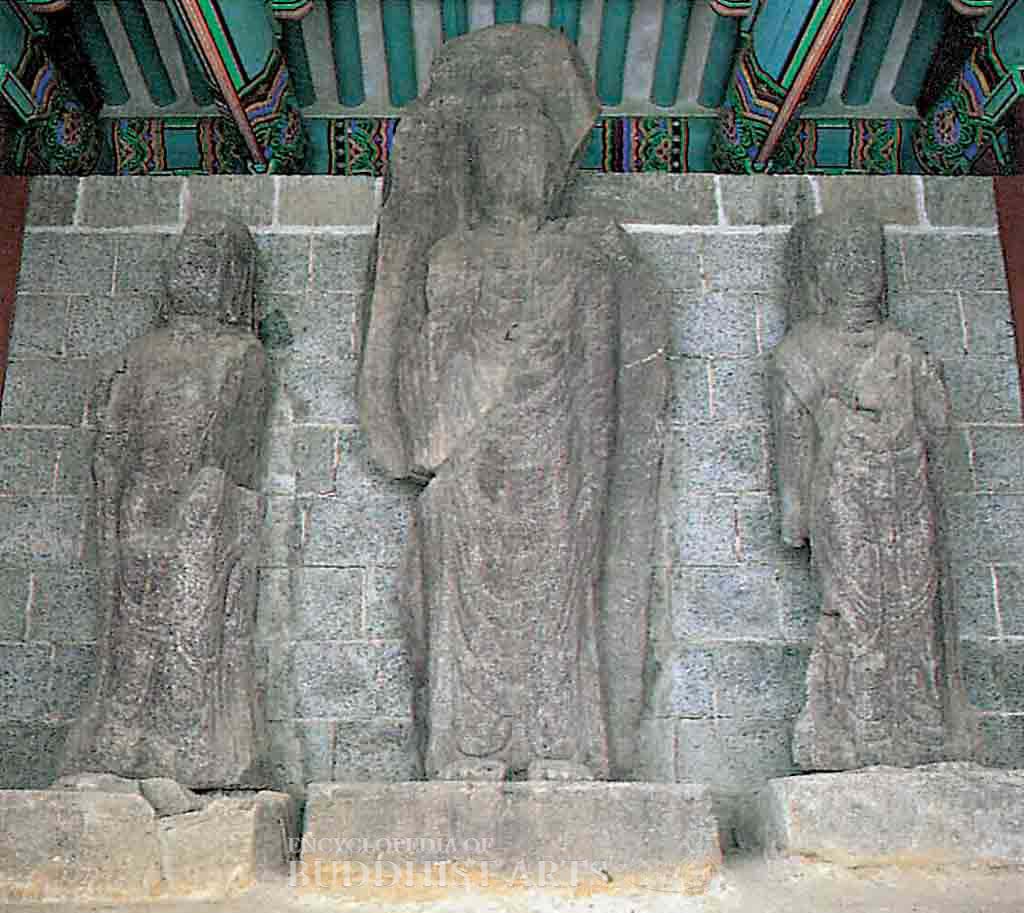
The three figures depict a Buddha and two attendant Bodhisattvas. They are carved in relief and their flatness dates them to the early Goryeo dynasty (918–1392). They originally had mandorlas and pedestals but the statues were moved. The group was listed as Treasure No. 197 in 1963.
The central Buddha wears a close fitting monastic robe that covers both shoulders. The figure stands with the right hand in abhaya (fearlessness) mudra and the left hand in varada (wish-granting) mudra. There is some remnant of the plain mandorla.
The flanking Bodhisattvas wear stoles that loop twice over the skirt. They are arranged symmetrically, with the hand furthest from the Buddha raised in abhaya (fearlessness) mudra and the hand nearest to him at their side. Only a small piece of their mandorlas remain.
For more details, go to the Encyclopedia of Buddhist Arts: Sculpture A-F, page 250.
Cite this article:
author = Hsingyun and Youheng and Lovelock, Yann and Chou, Yuan and Huntington, Susan and Edson, Gary and Neather, Robert,
booktitle = {Encyclopedia of Buddhist Arts: Sculpture A-F},
pages = 250,
title = {{Cheongyang: Buddha Triad}},
volume = 10,
year = {2016}}