
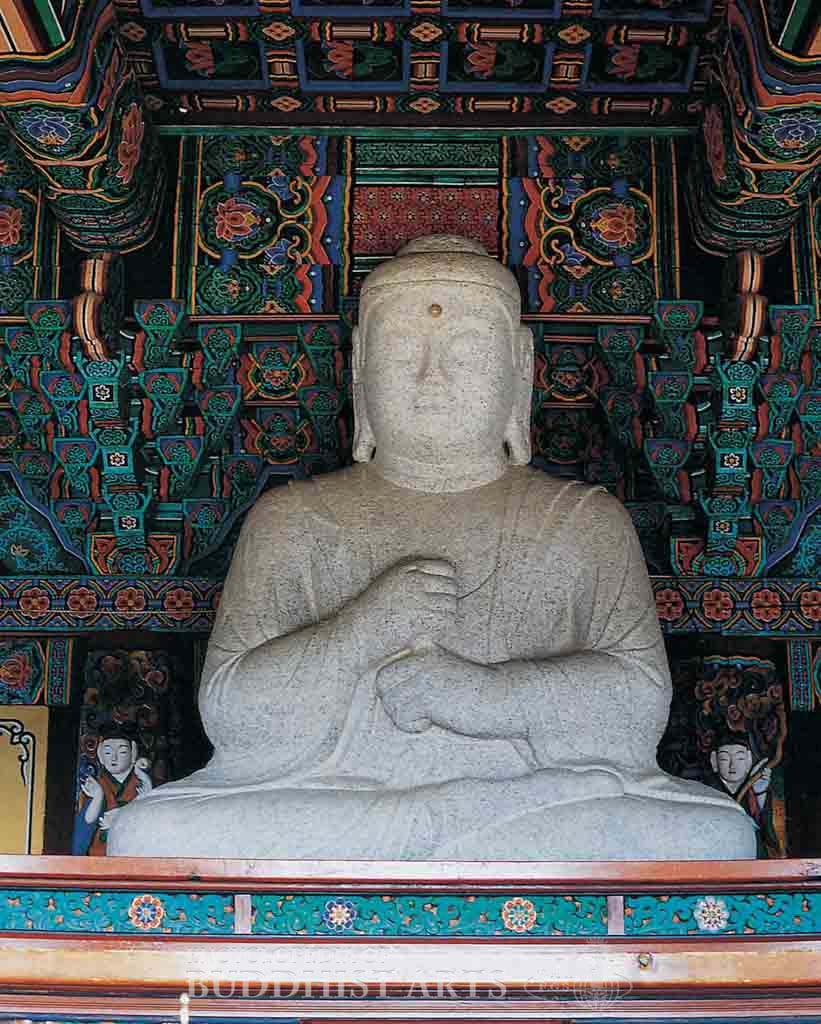
Cheongamsa Temple Sudoam Hermitage: Vairocana Buddha
Stone
Cheongamsa Temple Sudoam Hermitage: Vairocana Buddha
SOUTH KOREA, North Gyeongsang, Gimcheon; Unified Silla dynasty
The statue, believed sculpted in the late 9th century during the Unified Silla dynasty (668–935) has similarities to the Vairocana Buddha at Bulguksa Temple that was completed in 887. The statue was listed as Treasure No. 307 in 1963. One of its special features is its large size and despite the missing mandorla, the statue is in excellent condition. The Buddha sits in full lotus position with hands in the bodhyangi (wisdom fist) mudra. The figure’s monastic robe covers both shoulders and is opened at the front with shallow lines depicting plain folds. The Buddha’s face is square and has long, thin eyes, a small mouth, and elongated earlobes that reach to the shoulders. This combination of three elements was not used until 858 when the Vairocana Buddha at Borimsa Temple was created.
For more details, go to the Encyclopedia of Buddhist Arts: Sculpture A-F, page 247.
Cite this article:
author = Hsingyun and Youheng and Lovelock, Yann and Chou, Yuan and Huntington, Susan and Edson, Gary and Neather, Robert,
booktitle = {Encyclopedia of Buddhist Arts: Sculpture A-F},
pages = 247,
title = {{Cheongamsa Temple Sudoam Hermitage: Vairocana Buddha}},
volume = 10,
year = {2016}}