
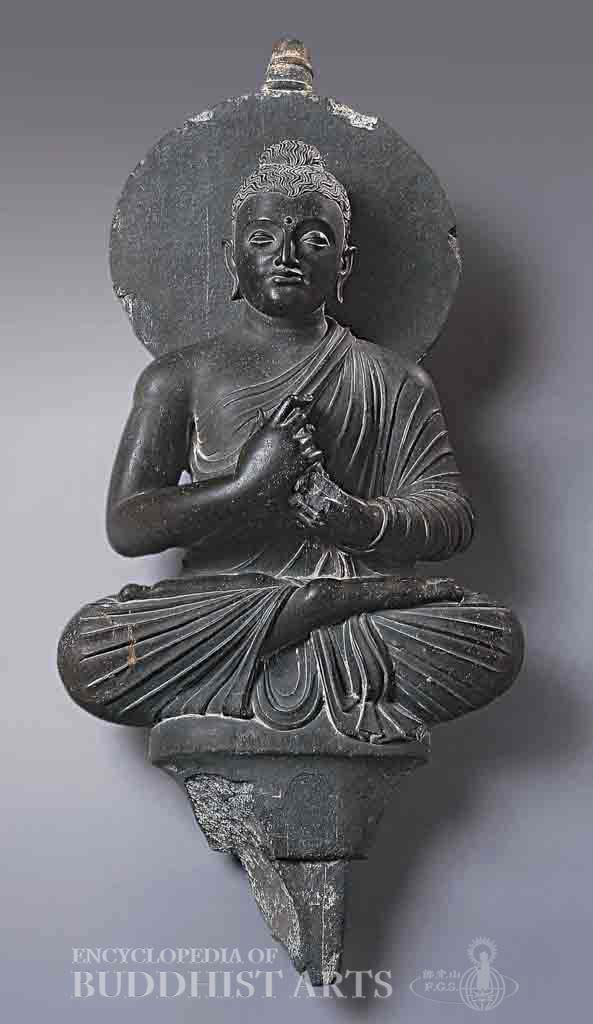
Seated Buddha
Schist
Seated Buddha
PAKISTAN; Kushan period
The statue was probably excavated from Peshawar. The distinct design at the bottom suggests it was intended for attachment to a separately constructed pedestal, whereas usually both pedestal and figure were made from a single block of stone. A pole-like structure above the plain nimbus belongs to the base of a missing canopy. The hands are in a mudra which suggests the statue represents the Buddha delivering his first teaching.
The Buddha sits in full lotus position, wearing a monastic robe that leaves the right shoulder bare. The raised folds are meticulously depicted, especially where the material is stretched over the knees.
For more details, go to the Encyclopedia of Buddhist Arts: Sculpture N-Sr, page 1029.
Cite this article:
Hsingyun, et al. "Seated Buddha." Encyclopedia of Buddhist Arts: Sculpture N-Sr, vol. 12, 2016, pp. 1029.
Hsingyun, Youheng, Yann Lovelock, Yuan Chou, Susan Huntington, Gary Edson, and Robert Neather. 2016. "Seated Buddha" In Encyclopedia of Buddhist Arts: Sculpture N-Sr, 12:1029.
Hsingyun, Youheng, Lovelock, Y., Chou, Y., Huntington, S., Edson, G., & Neather, R.. (2016). Seated Buddha. In Encyclopedia of Buddhist Arts: Sculpture N-Sr (Vol. 12, pp. 1029).
@misc{Hsingyun2016,
author = Hsingyun and Youheng and Lovelock, Yann and Chou, Yuan and Huntington, Susan and Edson, Gary and Neather, Robert,
booktitle = {Encyclopedia of Buddhist Arts: Sculpture N-Sr},
pages = 1029,
title = {{Seated Buddha}},
volume = 12,
year = {2016}}
author = Hsingyun and Youheng and Lovelock, Yann and Chou, Yuan and Huntington, Susan and Edson, Gary and Neather, Robert,
booktitle = {Encyclopedia of Buddhist Arts: Sculpture N-Sr},
pages = 1029,
title = {{Seated Buddha}},
volume = 12,
year = {2016}}