
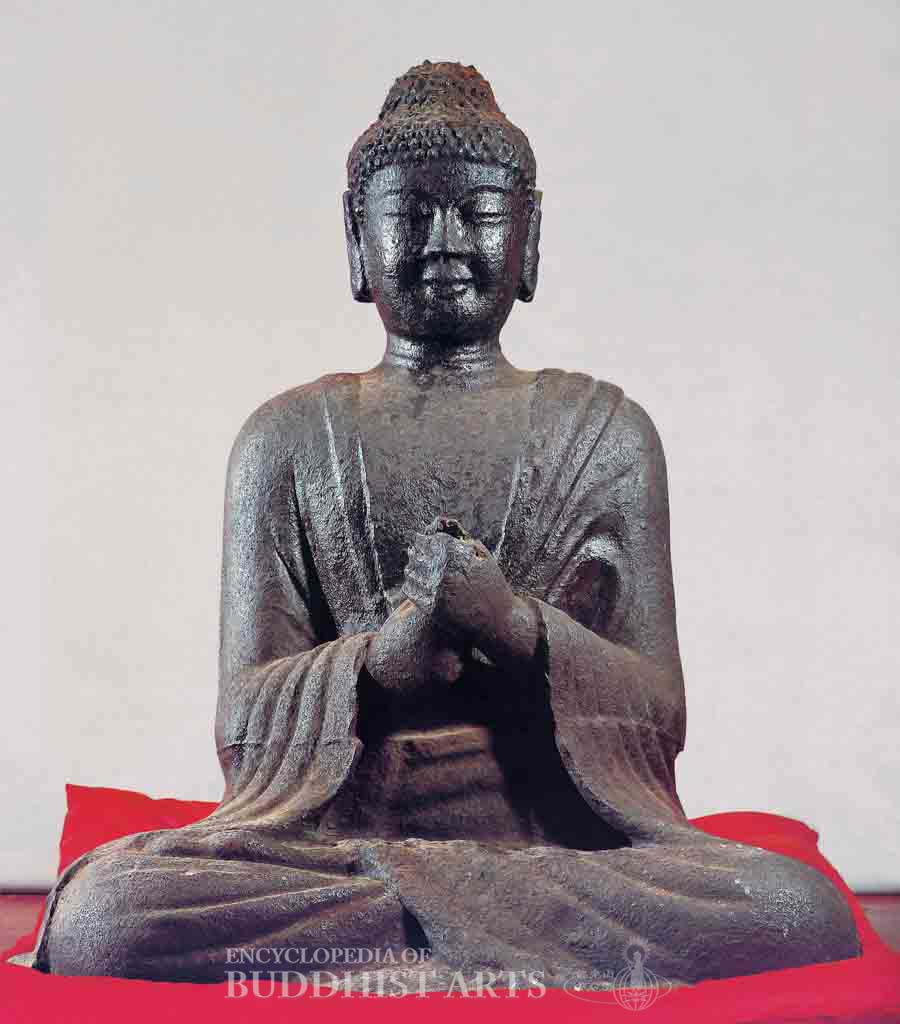
Jeungsimsa Temple: Vairocana Buddha
Iron
Jeungsimsa Temple: Vairocana Buddha
SOUTH KOREA, Gwangju; Unified Silla dynasty
The statue was moved from its original location at Jeungsimsa Temple to Vairocana Hall in 1934. It is contemporary with two other Vairocana Buddhas in Borimsa Temple and Dopiansa Temple that were completed during the Unified Silla dynasty (668–935). It was listed as Treasure No. 131 in 1963.
The Buddha wears a monastic robe that covers both shoulders and is open at the chest, falling in deeply molded folds over the arms and legs. The figure sits in half lotus position with hands likely in the bodhyangi (wisdom fist) mudra in which the forefinger of the right hand is enclosed in the left fist. The original throne and mandorla are missing.
For more details, go to the Encyclopedia of Buddhist Arts: Sculpture G-M, page 491.
Cite this article:
Hsingyun, et al. "Jeungsimsa Temple: Vairocana Buddha." Encyclopedia of Buddhist Arts: Sculpture G-M, vol. 11, 2016, pp. 491.
Hsingyun, Youheng, Yann Lovelock, Yuan Chou, Susan Huntington, Gary Edson, and Robert Neather. 2016. "Jeungsimsa Temple: Vairocana Buddha" In Encyclopedia of Buddhist Arts: Sculpture G-M, 11:491.
Hsingyun, Youheng, Lovelock, Y., Chou, Y., Huntington, S., Edson, G., & Neather, R.. (2016). Jeungsimsa Temple: Vairocana Buddha. In Encyclopedia of Buddhist Arts: Sculpture G-M (Vol. 11, pp. 491).
@misc{Hsingyun2016,
author = Hsingyun and Youheng and Lovelock, Yann and Chou, Yuan and Huntington, Susan and Edson, Gary and Neather, Robert,
booktitle = {Encyclopedia of Buddhist Arts: Sculpture G-M},
pages = 491,
title = {{Jeungsimsa Temple: Vairocana Buddha}},
volume = 11,
year = {2016}}
author = Hsingyun and Youheng and Lovelock, Yann and Chou, Yuan and Huntington, Susan and Edson, Gary and Neather, Robert,
booktitle = {Encyclopedia of Buddhist Arts: Sculpture G-M},
pages = 491,
title = {{Jeungsimsa Temple: Vairocana Buddha}},
volume = 11,
year = {2016}}