
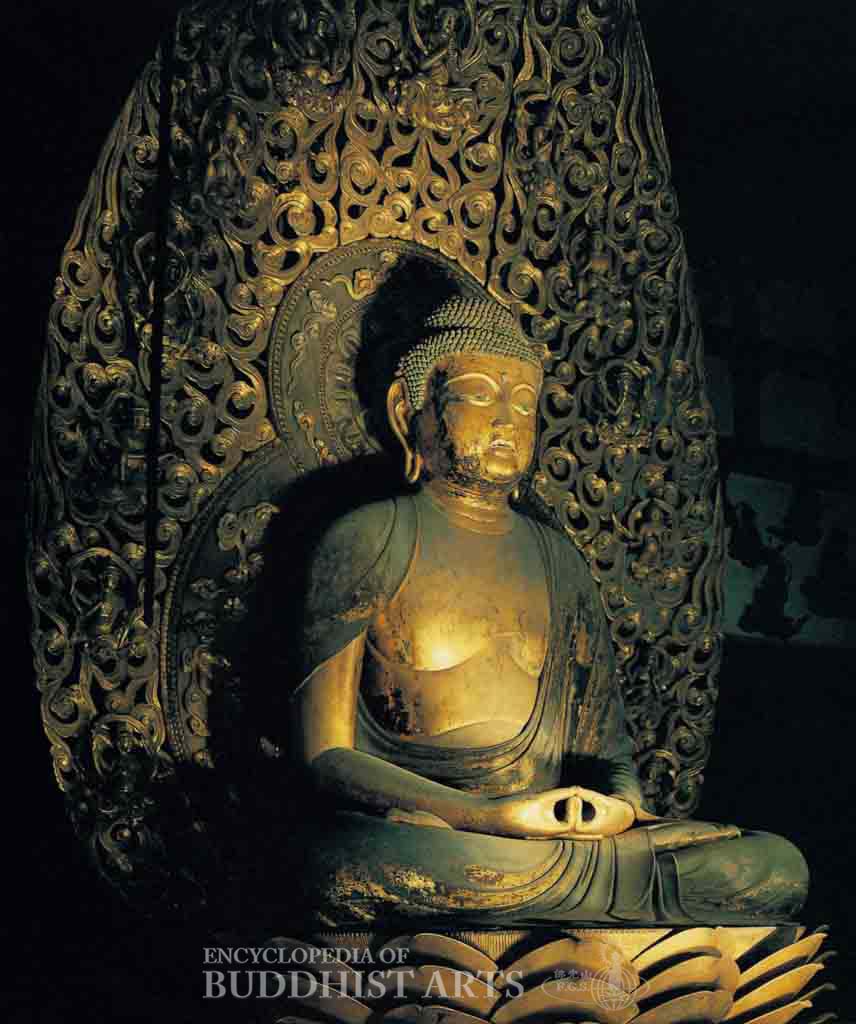
Amitabha Buddha by Jocho; Heian period, dated 1053
Cypress wood
Jocho
JAPAN, Kyoto; Heian period
The son of Kosho, Jocho was a Buddhist sculptor. His many contributions include the founding of the Shichijo Buddhist Sculpture Workshop. He is also known for perfecting the joint-block construction technique in producing large Buddha statues.
He sculpted the Buddha statues in the Amitabha Hall of Hojoji Temple in Kyoto in 1020 alongside his father, and in 1022, upon completing the statues in the Golden Hall and five-story pagoda, Jocho was awarded the title of Hokkyo (Dharma Bridge), thus becoming the first sculptor to be listed in the ranking system for monks in Japan. He was later honored as Hogen (Dharma Eye) for his contributions in restoring the statues in Kofukuji Temple in Nara. Henceforth, the social status of sculptors was greatly raised. In 1053, Jocho sculpted the 279 cm high Amitabha Buddha in the Phoenix Hall of Byodoin Temple in Kyoto. This masterpiece, currently listed as a National Treasure, was created during the peak of his career and is his only extant piece.
His well-proportioned Buddha statues feature round faces and low-relief draperies with soft and elegant curves. The refined and classical style reflects the noble and aesthetic conception of traditional Japanese society. Jocho’s statues became the ideal model for the creation of Buddha statues during the Heian period (794–1185). After he passed away, his son Kakujo and foremost disciple Chosei took over the workshop. His organizational structure was further branched into three different schools: Inpa, Enpa, and Kei; all of which imparted vast influences on Japan’s sculptural art history.
For more details, go to the Encyclopedia of Buddhist Arts: People, page 123.
Cite this article:
author = Hsingyun and Youheng and Youlu and Pokorski, Stefanie and Yichao and Mankuang and Miaohsi,
booktitle = {Encyclopedia of Buddhist Arts: People },
pages = 123,
title = {{Jocho}},
volume = 19,
year = {2016}}