
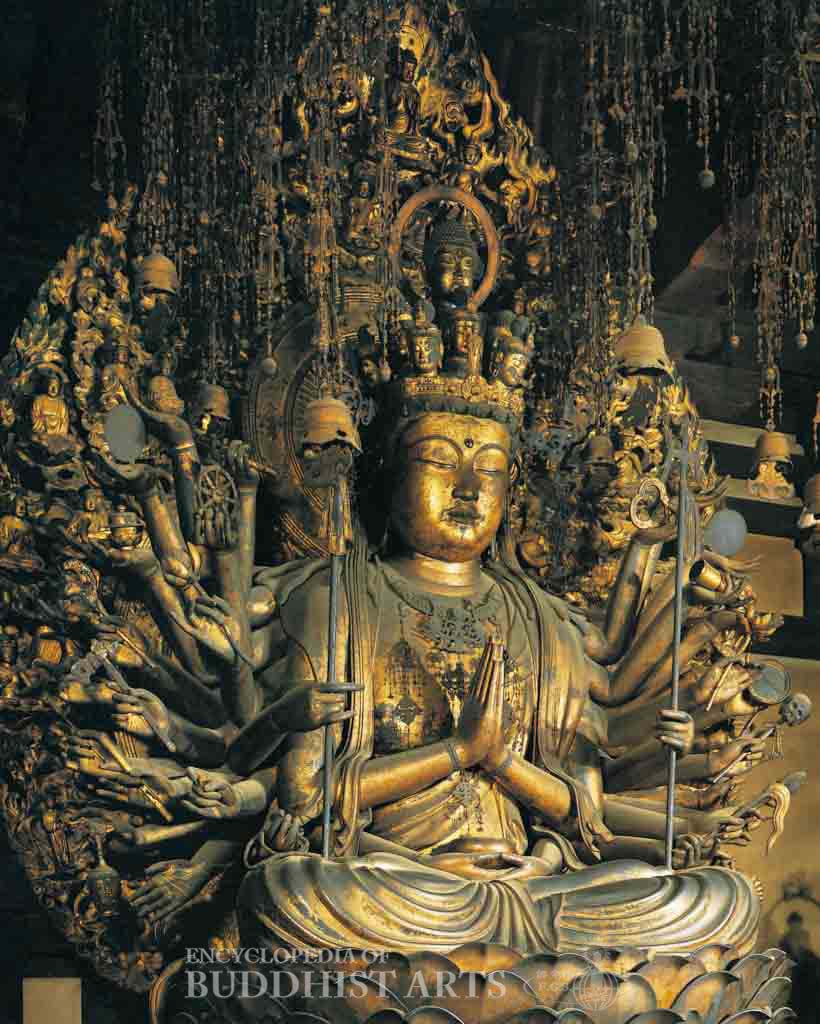
Thousand-Armed Avalokitesvara by Tankei; Kamakura period, dated 1254
Cypress wood
Tankei
JAPAN, Kyoto; Kamakura period
Like his father Unkei, Tankei was a Buddhist sculptor of the Kei school. The father and son pair led the sculpting industry during the Kamakura period (1185–1333) and were regarded as “Un and Tan, the Two Kei.” When he was young, Tankei apprenticed under his father in statue restoration work at Kofukuji Temple and Todaiji Temple in Nara. He was also involved in the restoration of the sculptures in the lecture hall of Toji Temple in Kyoto between 1190 and 1199, and the creation of the Virupaksa Heavenly King statue at the south gate. Furthermore, together with Koben and Unga, Tankei and Unkei completed the statue Virupaksa Heavenly King at the middle gate of Toji Temple.
In 1203, Tankei worked with Unkei, Kaikei, and Jokaku on Narayana and Guhyapada at the south gate of Toji Temple. He was also responsible for the making of Dhrtarastra Heavenly King in the North Octagonal Hall of Kofukuji Temple in 1208. He also constructed a statue for the nine-story pagoda at Hosshoji Temple in Kyoto in 1213. In the same year, Unkei was bestowed the honorable title Hoin (Dharma Seal), one of the highest ranks honored to a Buddhist artists in Japan, but he handed the honor down to Tankei.
When his father passed away in 1223, Tankei took responsibility of the sculpture workshop. Between 1251 and 1254, at age 82, he led his disciples in the creation of the Thousand-Armed Avalokitesvara of Sanjusangendo Temple in Kyoto, as well as 1,000 standing statues of Avalokitesvara Bodhisattva. Tankei infused elements of the Chinese Buddhist painting style of Song dynasty (960–1279) and local art into his statues, which appear realistic as a result. This project is considered the greatest achievement in Tankei’s career. The Thousand-Armed Avalokitesvara was later listed as a National Treasure of Japan, and nine of the 1,000 standing sculptures carrying the signatures of Tankei were listed as Important Cultural Properties. Another extant work is the triad of Vaisravana, Mahadevi, and Kumara collected as an Important Cultural Property at Sekkeiji Temple in Kochi.
For more details, go to the Encyclopedia of Buddhist Arts: People, page 254.
Cite this article:
author = Hsingyun and Youheng and Youlu and Pokorski, Stefanie and Yichao and Mankuang and Miaohsi,
booktitle = {Encyclopedia of Buddhist Arts: People },
pages = 254,
title = {{Tankei}},
volume = 19,
year = {2016}}