
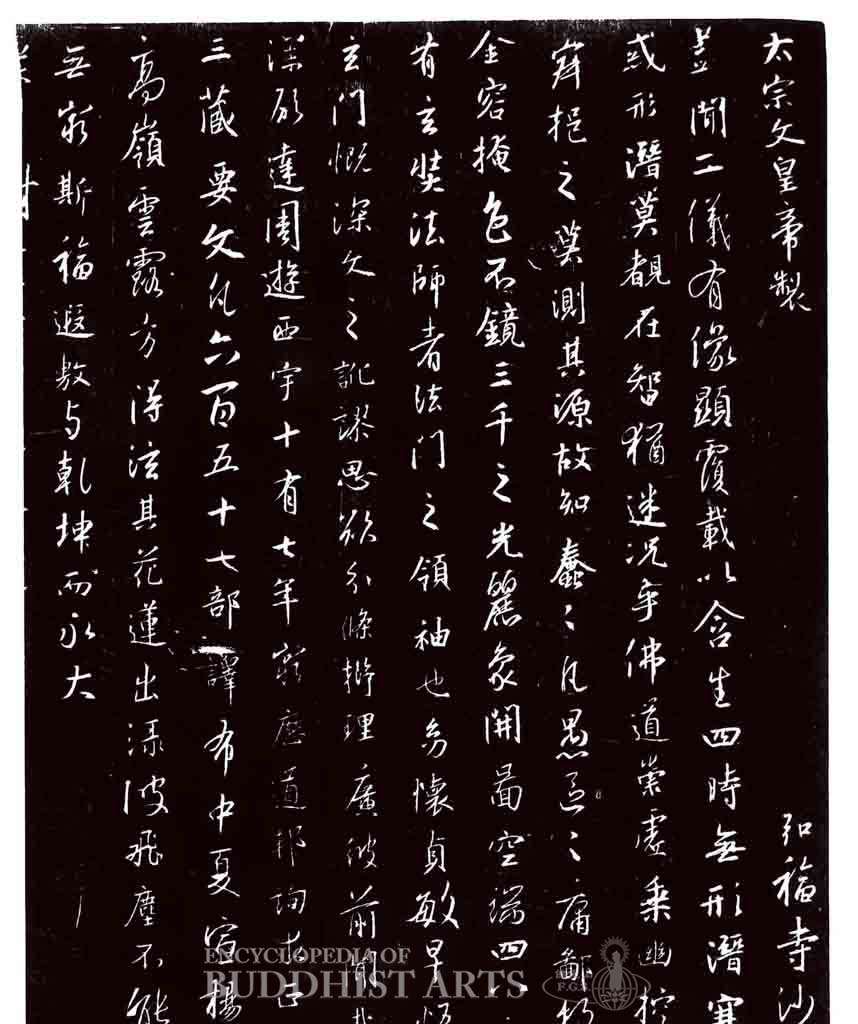
Hongfu Temple: Preface to Sagely Teachings in Wang Xizhi’s Calligraphy (detail)
Rubbing
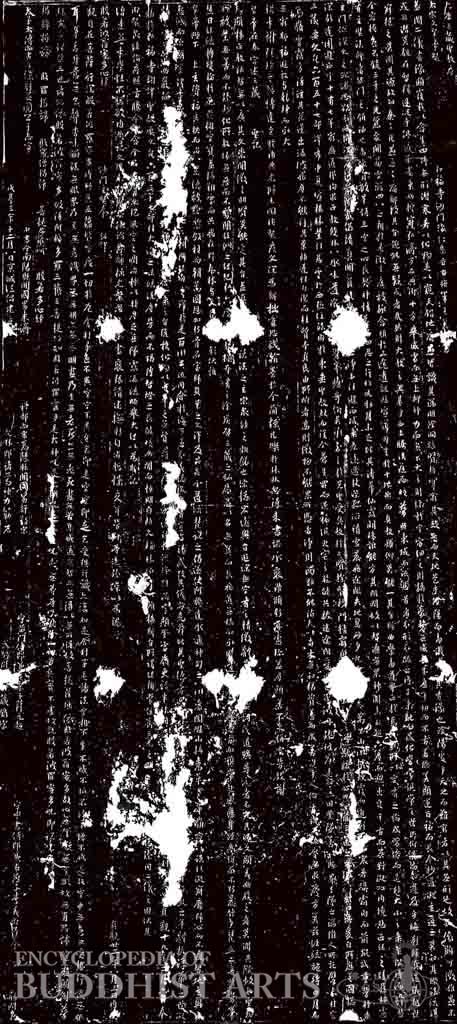
Hongfu Temple: Preface to Sagely Teachings in Wang Xizhi’s Calligraphy
Rubbing
Hongfu Temple: Preface to Sagely Teachings in Wang Xizhi’s Calligraphy
CHINA, Shaanxi, Xi’an; Tang dynasty
Inscribed on a stele located at Hongfu Temple in Shaanxi, this text is also referred to as Preface to Sagely Teachings of the Great Tang Dynasty Tripitaka Master. It was composed by Emperor Taizong (reigned 626–649) of the Tang dynasty in commendation of Master Xuanzang, a monk who journeyed to India in search of Buddhist sutras. Master Huairen was tasked by the Emperor to compile the numerous characters written by Wang Xizhi in running script to produce an inscription of this preface in Wang’s style. This compilation was the first collation project of its kind, and was considered an important and influential undertaking. Furthermore, it is highly unique among stone inscription works. Compiled by Huairen, the text was transferred onto the stele face by Zhuge Shenli and engraved by Zhu Jingcang. There are a total of 30 lines of 85 to 86 characters. Numerous rubbings dating to the Song dynasty (960–1279) remain today.
Huairen was skilled in literature and writing, and studied Wang Xizhi’s calligraphy for several years, mastering the style and features of his techniques. The Preface to Sagely Teachings in Wang Xizhi’s Calligraphy was composed using characters previously written by Wang Xizhi in various works. Characters with no precedents in Wang’s handwriting were configured by scaling and assembling character parts and strokes based on other references that were close in form. These characters were then carefully traced onto the stele to retain as much of their original appearances as possible. 25 years were spent on this delicate yet meticulous task. Despite its synthesized origin, the calligraphy features strokes that are lively and varied, and the text is elegantly presented within a well-ordered layout. The result is a paragon of running script calligraphy that has been widely emulated by subsequent generations.
Wang Xizhi, known also as Yishao or Danzhai, was a famous calligrapher of the Eastern Jin dynasty (317–420) who was adept in the scripting of fine calligraphy. Variety in form and structure was a key feature of his works. Wang’s style was highly influential, and he was referred to by later generations as the Sage of Calligraphy.
For more details, go to the Encyclopedia of Buddhist Arts: Calligraphy, page 99.
Cite this article:
author = Hsingyun and Youheng and Youlu and Pokorski, Stefanie and Mankuang and Edson, Gary,
booktitle = {Encyclopedia of Buddhist Arts: Calligraphy },
pages = 99,
title = {{Hongfu Temple: Preface to Sagely Teachings in Wang Xizhi’s Calligraphy}},
volume = 17,
year = {2016}}