
Wenfeng Pagoda
Wenfeng Pagoda
CHINA, Hubei, Jingmen
The original pagoda was built in 880 during the Tang dynasty. It was destroyed and rebuilt in its present form between 1389 and 1390 during the Ming dynasty. In 1540, Emperor Jiajing (reigned 1521–1566) of the Ming dynasty ordered a temple to be built near the pagoda. However, the temple was destroyed in the late Qing dynasty (1644–1911). The pagoda was repaired some time during the rule of Emperor Daoguang (reigned 1821–1850) of the Qing dynasty. It was listed as a National Cultural Heritage Site in 2006.
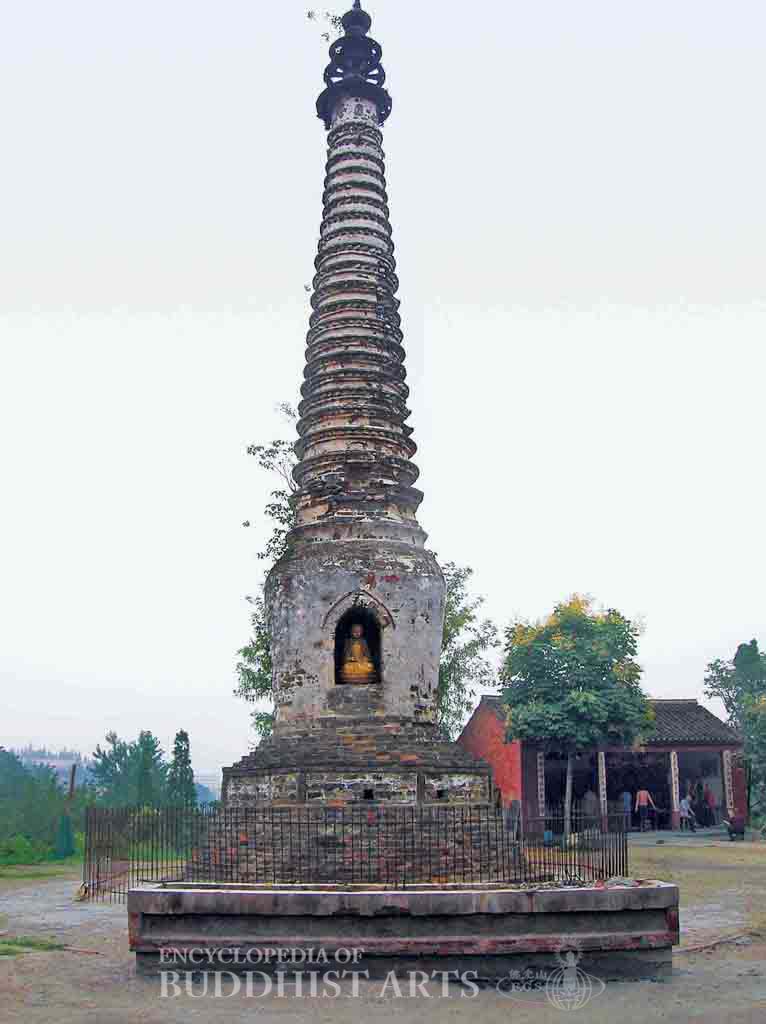
The pagoda is constructed from gray brick and has a height of 21.5 m. It stands on an octagonal Sumeru base. The body is in the shape of an inverted bowl, on one side of which there is a niche with a seated Buddha inside. The spire has 21 stacked rings followed by three canopies and a jewel. Two tablets from the rule of Emperor Daoguang are inlaid into the pagoda body. They record the history of repairs as well as the names of donors.
For more details, go to the Encyclopedia of Buddhist Arts: Architecture T-Z, page 1269.
Cite this article:
author = Hsingyun and Youheng and Johnson, Peter and Mankuang and Lancaster, Lewis,
booktitle = {Encyclopedia of Buddhist Arts: Architecture T-Z},
pages = 1269,
title = {{Wenfeng Pagoda}},
volume = 4,
year = {2016}}