
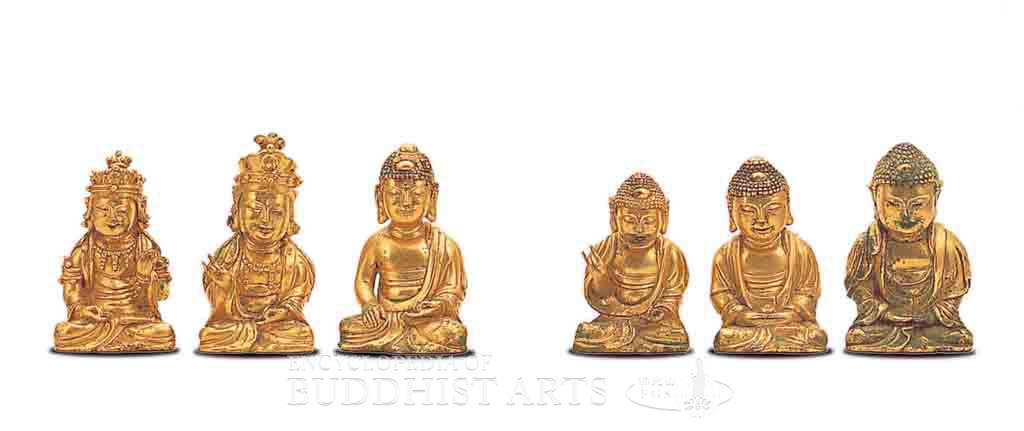
Sujongsa Temple Five-Tier Pagoda: Seated Buddhas and Bodhisattvas
Gilt copper alloy
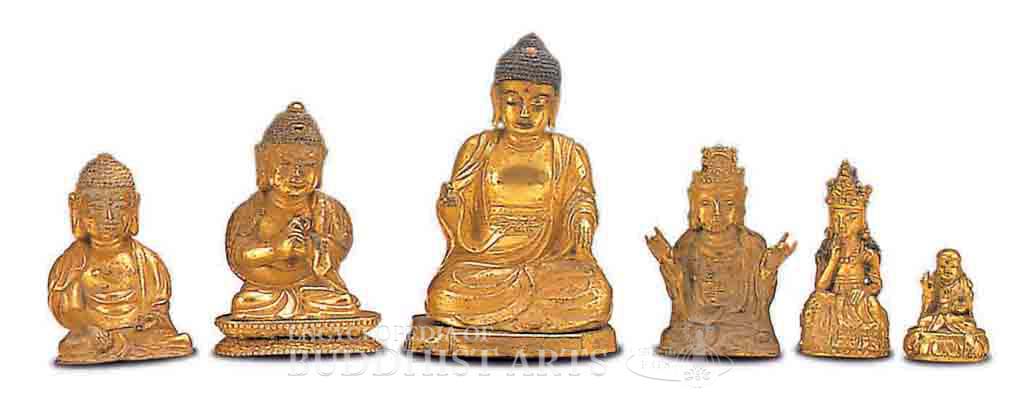
Sujongsa Temple Five-Tier Pagoda: Seated Buddhas and Bodhisattvas
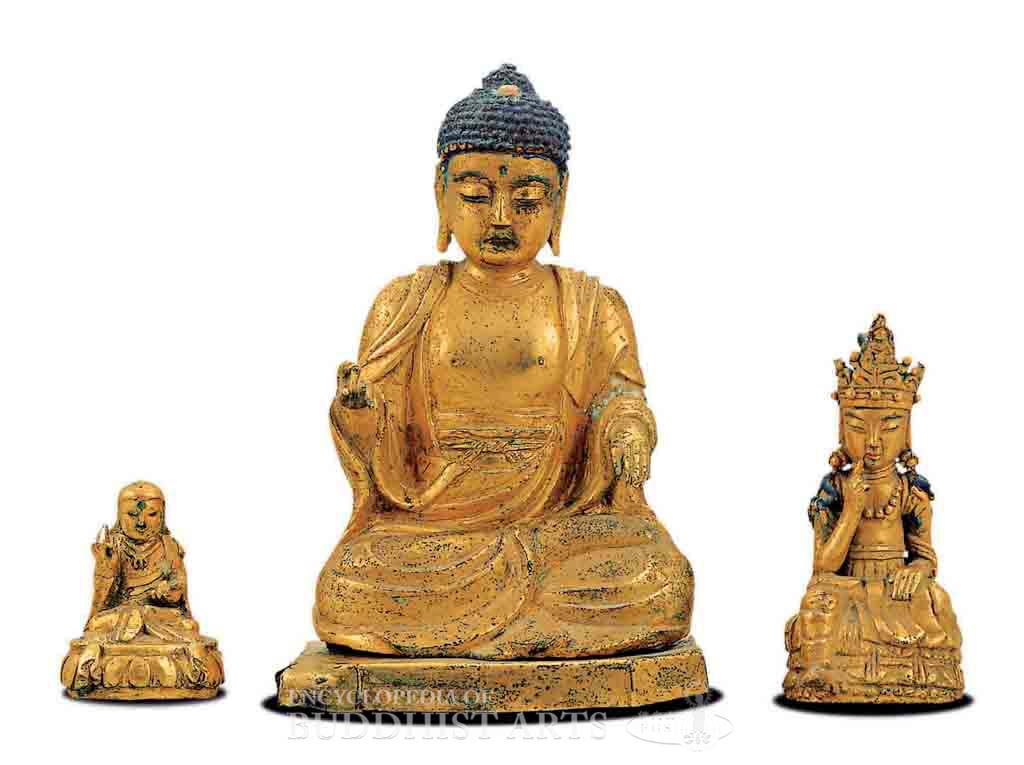
Sujongsa Temple Five-Tier Pagoda: Sakyamuni Buddha, Bodhisattva in Contemplation, and Ksitigarbha Bodhisattva
Sujongsa Temple Five-Tier Pagoda: Seated Buddhas and Bodhisattvas
SOUTH KOREA, Gyeonggi, Namyangju; Joseon dynasty
Eight of these fifteen figurines were discovered in the foundation of the pagoda and another four in the first tier roof. Their styles vary between the early and later periods of the Joseon dynasty (1392–1910).
The set of three figures from the early Joseon dynasty include a 13.8 cm Buddha, a 9.4 cm Bodhisattva in Contemplation, and a 5.2 cm Ksitigarbha Bodhisattva holding a wish-fulfilling jewel and wearing a hood. An inscription on the Buddha’s midriff records that its subject is Sakyamuni and that a concubine of King Seongjong donated it in 1493. The features on the Buddha image, especially the bejeweled usnisa, were developed from the Goryeo dynasty (918–1392). The differences in style and size suggest the figures were not made as a set.
The remaining 12 figurines date from late Joseon dynasty. The seated Vairocana is making a mudra and has an inscription indicating the Princess Dowager commissioned it in 1628. The image resembles the wooden Buddha statue sculpted in 1482 and kept in the National Museum of Korea. There are five other Buddhas, identified by their curled hair and usnisa, as well as three more crowned Bodhisattvas.
For more details, go to the Encyclopedia of Buddhist Arts: Sculpture St-Z, page 1173.
Cite this article:
author = Hsingyun and Youheng and Lovelock, Yann and Chou, Yuan and Huntington, Susan and Edson, Gary and Neather, Robert,
booktitle = {Encyclopedia of Buddhist Arts: Sculpture St-Z},
pages = 1173,
title = {{Sujongsa Temple Five-Tier Pagoda: Seated Buddhas and Bodhisattvas}},
volume = 13,
year = {2016}}