
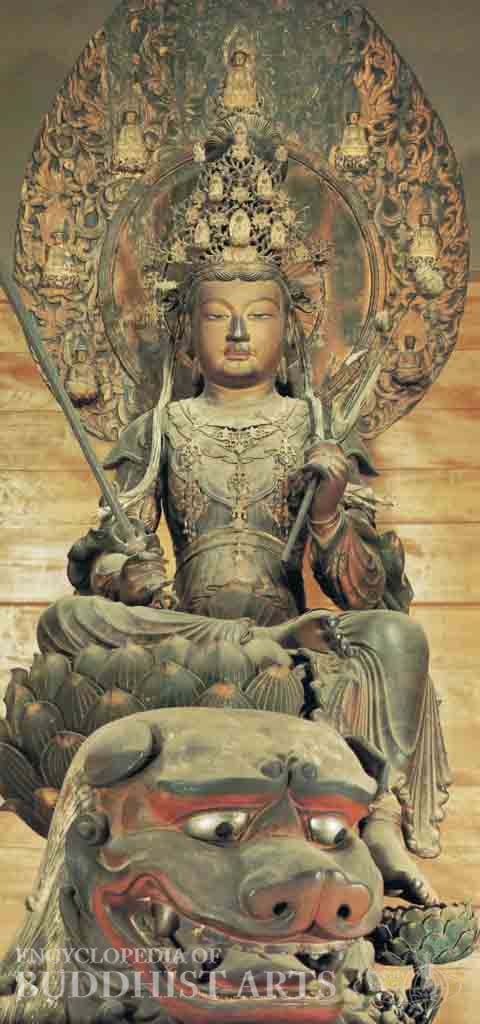
Manjusri Bodhisattva by Kaikei; Kamakura period, dated 1203
Wood
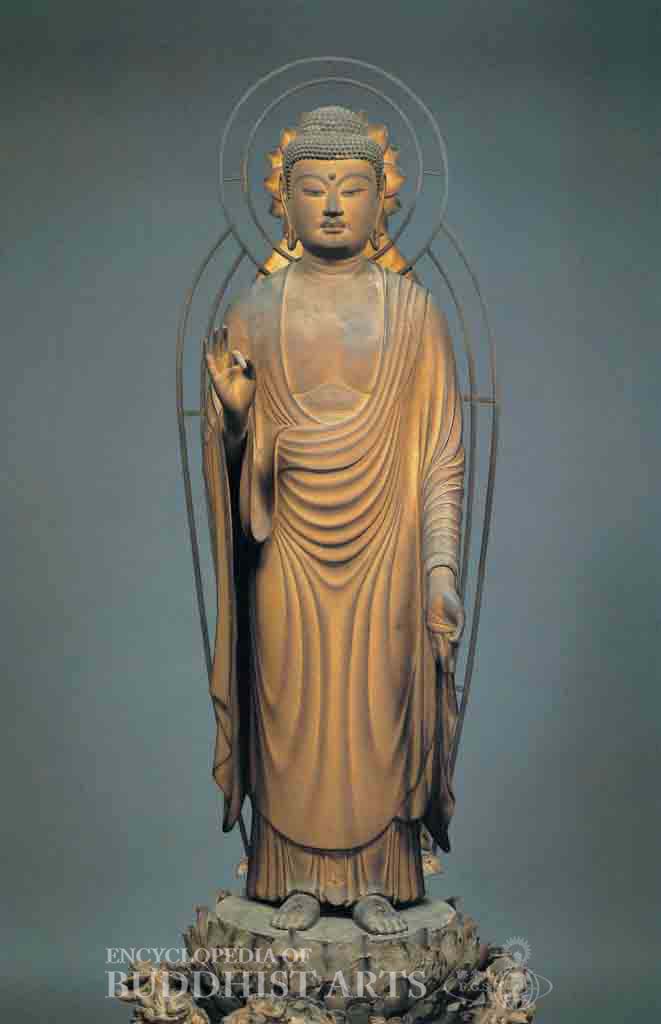
Standing Amitabha Buddha by Kaikei; Kamakura period
Wood
Kaikei
JAPAN; Heian to Kamakura period
Kaikei, also known as Tanba Koshi or Echigo Hokkyo, was an acclaimed Kei school sculptor who lived and worked in Nara. An apprentice of Kokei, he was awarded the status of both Hogen (Dharma Eye) and Hokkyo (Dharma Bridge), two of the highest ranks awarded to Buddhist artists in Japan. Alongside Unkei, he is regarded as one of the Two Sculptors of the Kamakura period (1185–1333). He was a disciple of monk Chogen, as well as a devoted follower of the Pure Land school.
Todaiji Temple in Nara was damaged in 1180, and Kaikei served as an integral figure in its restoration. Beginning in 1194, he traveled to China on three separate occasions to study Song dynasty (960–1279) art and find inspiration for a series of statuary projects he was undertaking. Based on what he saw in several Song paintings, Kaikei sculpted a collection of large Buddha statues. He assisted in the construction of Narayana and Guhyapada at Todaiji Temple in 1203 alongside Jokaku, Unkei, and Tankei. The guardians, located at the south gate, are the largest of their kind in Japan. Because of their magnificence and grandeur, they served as models for the sculpting of guardian statues in later generations. They are listed as a National Treasure.
Kaikei’s later style placed an emphasis on details. Refined drapery, graceful contour lines, and realistic elegance comprised the distinctive look which was referred to as the Annami style. His 98.7 cm high depiction of Amitabha Buddha was ingeniously decorated with gold dust and flakes. This element of embellishment became a trademark of Kaikei’s and also served as a model for Amitabha Buddha statues for later artists.
Of Kaikei’s nearly 40 works that remain extant, several are listed as either Important Cultural Properties or National Treasures, and are Buddhist works enshrined in temples around the country. One such example of a National Treasure is his Amitabha Buddha Triad located at Jodoji Temple in Hyogo. Other fine examples of his extant work include the Manjusri Bodhisattva in Abe Monjuin Temple in Sakurai, Nara and Ksitigarbha Bodhisattva in Todaiji Temple.
For more details, go to the Encyclopedia of Buddhist Arts: People, page 128.
Cite this article:
author = Hsingyun and Youheng and Youlu and Pokorski, Stefanie and Yichao and Mankuang and Miaohsi,
booktitle = {Encyclopedia of Buddhist Arts: People },
pages = 128,
title = {{Kaikei}},
volume = 19,
year = {2016}}