
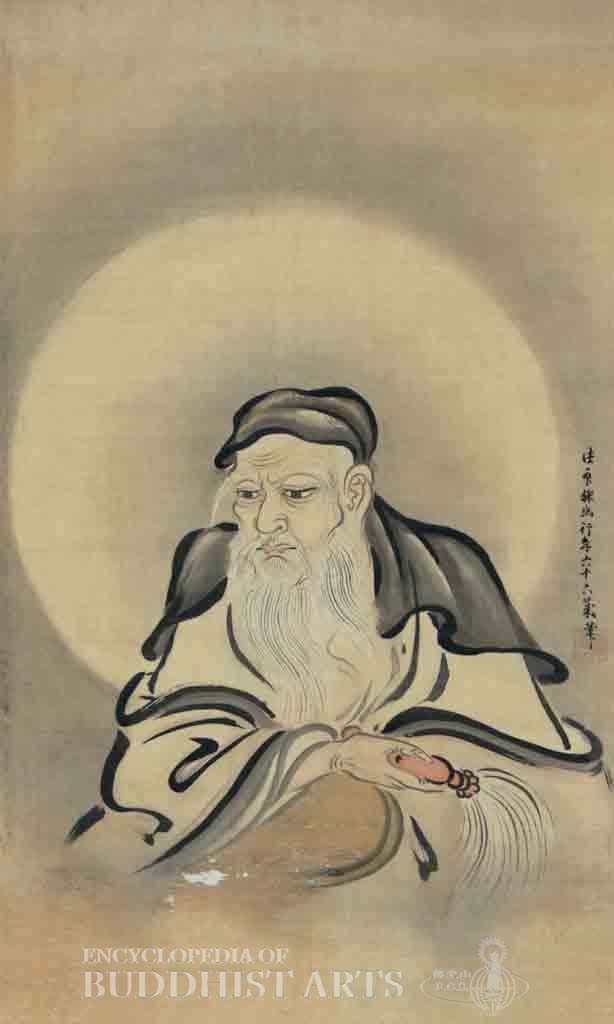
Vimalakirti by Kano Tanyu; Edo period
Ink and color on paper
Kano Tanyu
JAPAN, Kyoto; Momoyama to Edo period (1573–1868)
Kano Tanyu was a painter and monk with an original name of Uneme, later being known as Morinobu before renouncing under the Dharma name Tanyu. From Yamashiro (present day Kyoto), he was the grandson of the famed painter Kano Eitoku, and son of Takanobu. By the age of 16, his skills were so refined that he became the imperial painter for Tokugawa Bakufu.
He excelled in painting landscapes, flowers, birds, and Buddhist and Daoist figures, and he was skilled in the Yamato-e and ink painting techniques. Among Kano’s works, Sakyamuni Buddha Triad, Avalokitesvara Bodhisattva, and others were illustrated in ink with a simple and succinct style that eventually replaced the style of the Azuchi-Momoyama period (1573–1615) and established the foundation for the style of the Kano school during the Edo period (1615–1868) that influenced later generations.
Surviving works by Kano include Vimalakirti, which he illustrated at the age of 66 and is now kept at Daitokuji Temple in Kyoto. Three additional paintings comprising The Three Teachings, display Sakyamuni Buddha in the middle flanked by Confucius and Laozi. This depiction signifies the amalgamation of Buddhist, Confucian, and Daoist philosophies. Kano’s ink painting of Sakyamuni Buddha is retained in the abbot’s quarters of Daitokuji Temple.
For more details, go to the Encyclopedia of Buddhist Arts: People, page 132.
Cite this article:
author = Hsingyun and Youheng and Youlu and Pokorski, Stefanie and Yichao and Mankuang and Miaohsi,
booktitle = {Encyclopedia of Buddhist Arts: People },
pages = 132,
title = {{Kano Tanyu}},
volume = 19,
year = {2016}}