
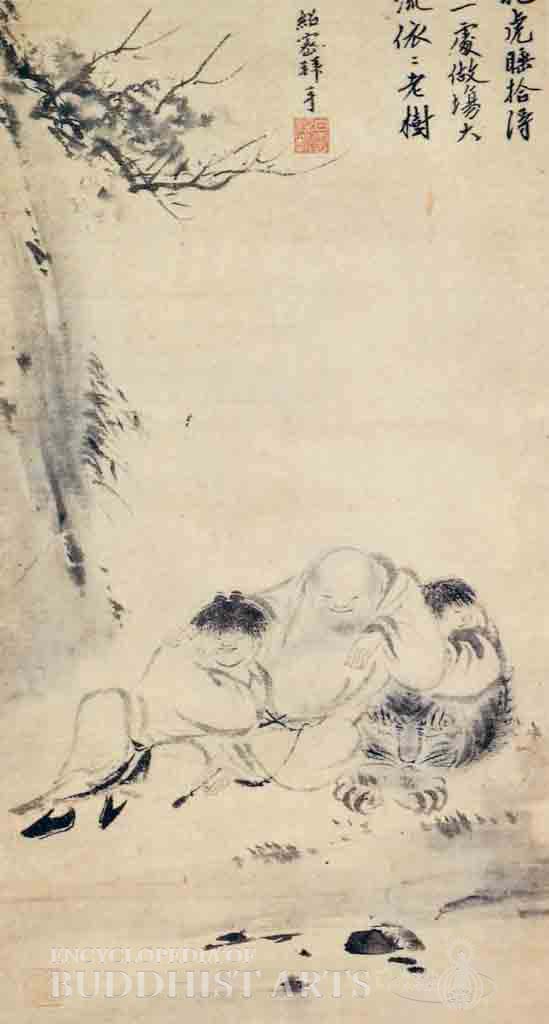
Four Sleepers by Mokuan Reien; Yuan dynasty
Ink on paper

Budai by Mokuan Reien; Yuan dynasty
Ink on paper
Mokuan Reien
JAPAN; Kamakura to Nanbokucho period
Mokuan Reien was a monk and painter of the Kamakura (1185–1333) and Nanbokucho (1336–1392) periods, active in the first half of the 14th century. In about 1330, he traveled to China to study and visited many ancient temples in Jiangnan (region south of the Yangtze River), where he encountered Chan masters such as Yuejiang Zhenyin, Liao’an Qingyu, and Chushi Fanqi. Unable to return to Japan, he passed away in China around 1345. When his works were brought back to Japan, they were regarded as having been done by a monk painter of the Yuan dynasty (1271–1368).
Mokuan was a skilled painter of landscapes and Buddhist themes. His painting style followed that of what came out of the Chan school during the Southern Song dynasty (1127–1279). Using a thick ink-wash to lay the foundation of the work, he decorated his paintings with dry ink. Features of the figures he depicted were lightly line-drawn and clothes appear in darker ink contours. Each of his drawings are freely expressed and take on a carefree and realistic appeal.
Paintings by Mokuan include Four Sleepers, which illustrates Fenggan, Hanshan, Shide, and a tiger all sleeping together. The image is now kept at the Maeda Ikutokukai in Tokyo. His other painting of Budai was created while he was in charge of Buddhist Canon at Benjue Temple in Zhejiang, and is now kept at the MOA Museum of Art in Shizuoka. Both works are listed as Important Cultural Properties of Japan. In additional, his Avalokitesvara, painted in ink, is recorded in Appreciation of Paintings.
For more details, go to the Encyclopedia of Buddhist Arts: People, page 195.
Cite this article:
author = Hsingyun and Youheng and Youlu and Pokorski, Stefanie and Yichao and Mankuang and Miaohsi,
booktitle = {Encyclopedia of Buddhist Arts: People },
pages = 195,
title = {{Mokuan Reien}},
volume = 19,
year = {2016}}