
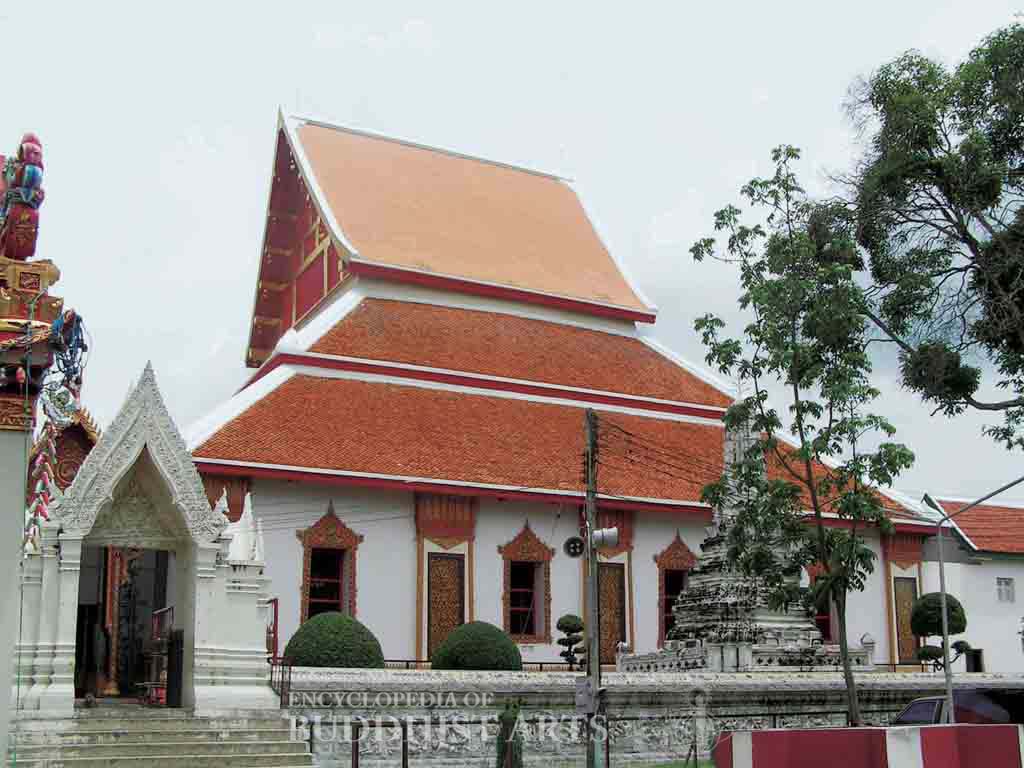
Wat Phanan Choeng: Main Hall
Wat Phanan Choeng
THAILAND, Ayutthaya
Phanan Choeng means the Great Seated Buddha, which refers to the temple’s main statue, Phra Chao Phanachoeng. The temple is located where the Pa Sak River and Chao Phraya River meet. It is a second class royal temple and is one of the oldest Buddhist temples in the area. According to royal chronicles, the temple was constructed in 1324, 26 years before Ayutthaya was founded. The main hall, which houses the statue of the Great Seated Buddha, was destroyed by Burmese troops during the fall of Ayutthaya and was rebuilt by King Rama IV (reigned 1851–1868). The king covered the statue with gold leaf and renamed it Phra Buddha Triratananayok. The temple has undergone regular expansion and restoration since its establishment. As part of the Historic City of Ayutthaya, the temple was listed as a UNESCO World Heritage Site in 1991.
The present temple consists of the main hall, lecture hall, pavilion, and Avalokitesvara Hall. The most important building is the main hall, which is 37 m high and 26 m wide, and houses the Phra Chao Phananchoeng. The statue is 19.2 m high, seated with hands in the bhumisparsa (earth-touching) mudra. The size of the statue suggests that the hall was built around it. Vividly carved reliefs of human figures decorate the wall panels. On the back wall, there are hundreds of niches containing small Buddha images. The Avalokitesvara Hall, adjacent to the main hall, is built in Chinese style and is three bays wide. It has a colorfully painted exterior. The roof is decorated with dragons and phoenixes, and the columns are wrapped with coiled dragons. The hall enshrines a Thousand-Armed Avalokitesvara statue, flanked by Skanda and Sangharama.
For more details, go to the Encyclopedia of Buddhist Arts: Architecture T-Z, page 1214.
Cite this article:
author = Hsingyun and Youheng and Johnson, Peter and Mankuang and Lancaster, Lewis,
booktitle = {Encyclopedia of Buddhist Arts: Architecture T-Z},
pages = 1214,
title = {{Wat Phanan Choeng}},
volume = 4,
year = {2016}}