
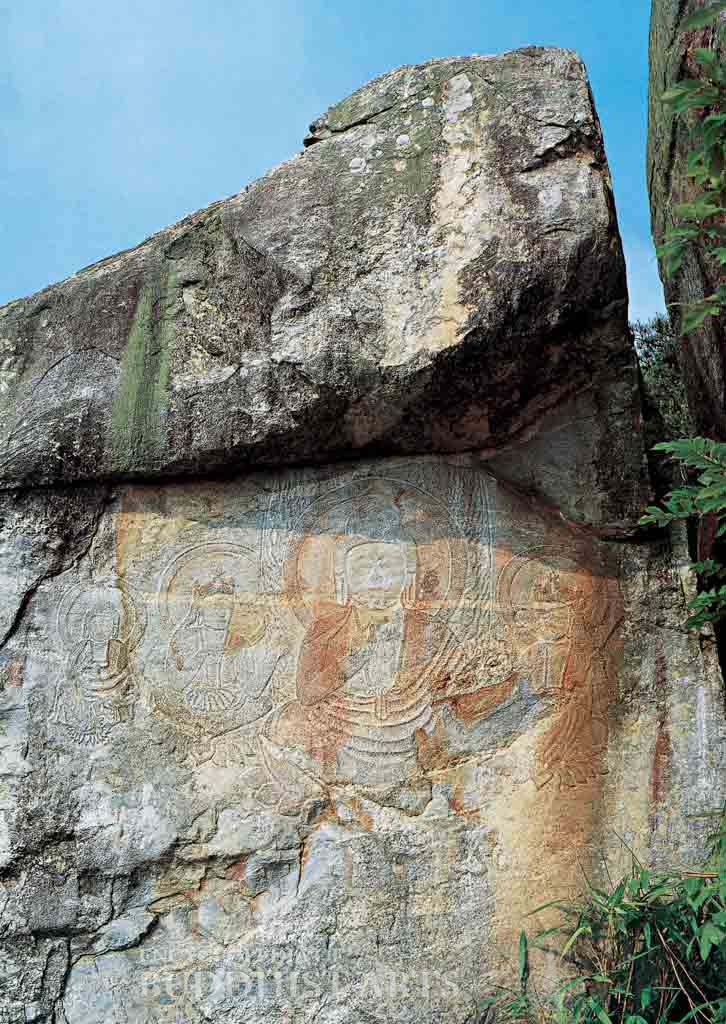
Noseokdong Rock Carvings
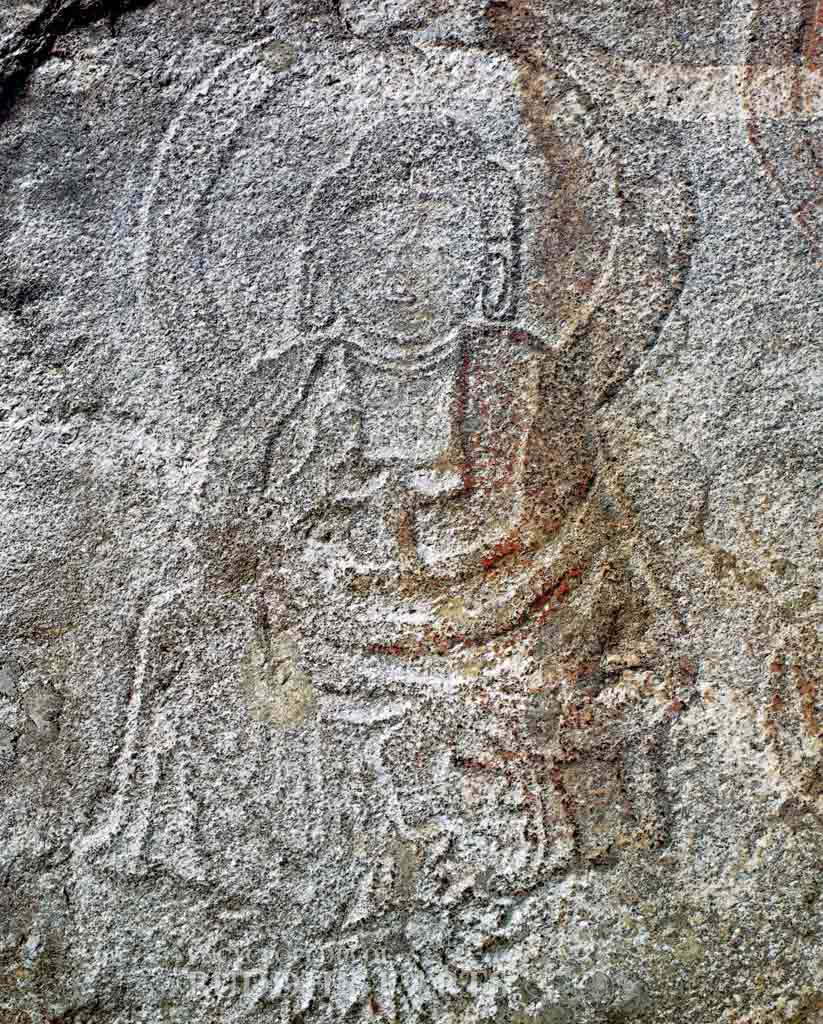
Noseokdong Rock Carvings: Seated Buddha
Noseokdong Rock Carvings
SOUTH KOREA, North Gyeongsang, Chilgok
Four figures dating from the late 7th century of the Silla dynasty are carved in low relief midway up the granite face beneath an overhang. The carvings were listed as Treasure No. 655 in 1979.
The 140 cm high central figure represents Amitabha Buddha seated on a lotus throne with the right hand raised in front of the chest. The folds of the robe ripple across the body, which is enclosed by a flame-patterned mandorla. The lower section of the carving has flaked away. A 90 cm high Avalokitesvara is to the right, wearing a triple-leaf crown and sitting on a similar throne. This figure is also damaged and discolored. Mahasthamaprapta, 80 cm in height, sits to the left and holds a lotus bud with both hands.. Both legs overhang the throne and are cross at the ankles. The fan-shaped folds at the top of the skirt are a stylistic feature of the Unified Silla dynasty (668–935). Figures seated on lotus thrones with legs crossed at the ankles while holding a lotus bud are rarely seen in Korea, although they are very common in the Longmen Grottoes and Yungang Grottoes in China.
A 115 cm high seated Buddha is located on the far right. He wears monastic robes with more emphatic lines to represent the folds. The Buddha sits in the relaxation posture with one leg overhanging the throne, displaying another rare position which could have been influenced by Chinese Buddhist images.
For more details, go to the Encyclopedia of Buddhist Arts: Caves Mo-S, page 1293.
Cite this article:
author = Hsingyun and Youheng and Johnson, Peter and Mankuang and Huntington, Susan and Edson, Gary and Neather, Robert,
booktitle = {Encyclopedia of Buddhist Arts: Caves Mo-S},
pages = 1293,
title = {{Noseokdong Rock Carvings}},
volume = 8,
year = {2016}}