
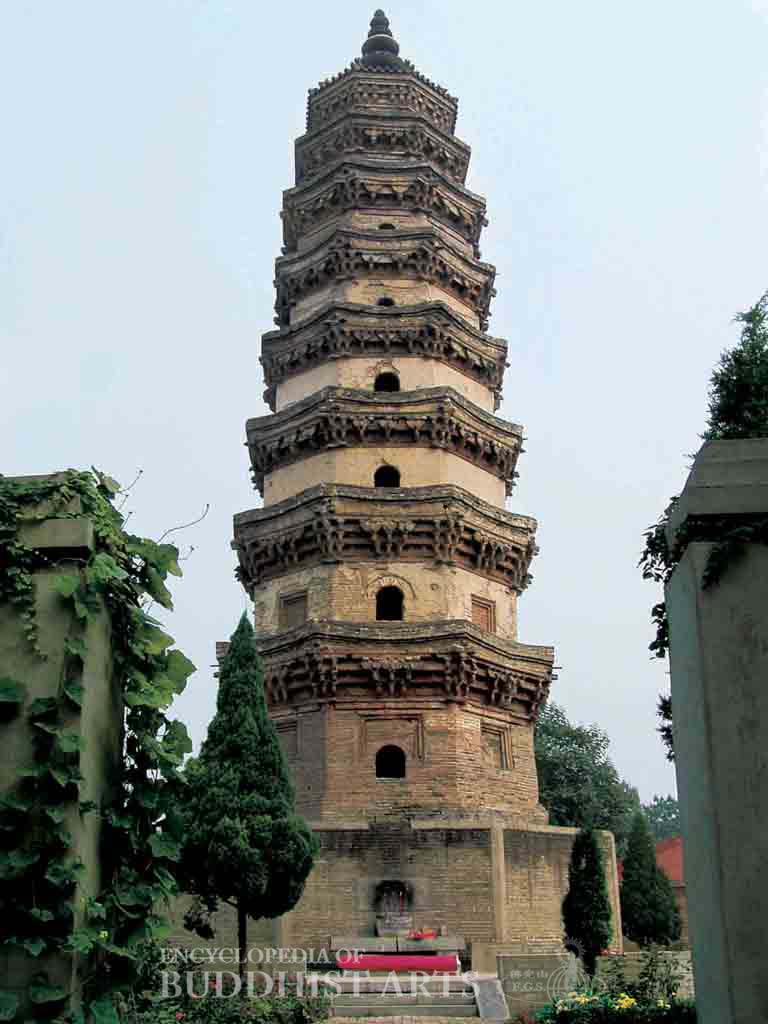
Putong Temple Pagoda
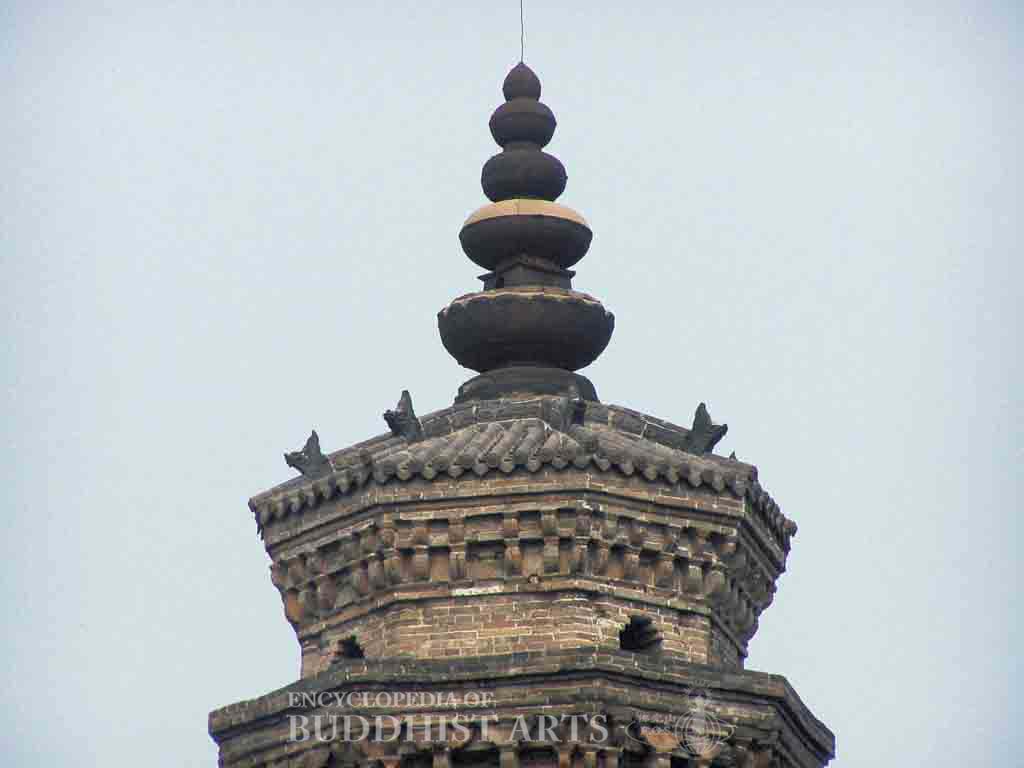
Putong Temple Pagoda (detail)
Putong Temple Pagoda
CHINA, Hebei, Xingtai
The pagoda was originally located on the grounds of Putong Temple, which was destroyed by flooding in 1478 during the Ming dynasty, leaving only the pagoda standing. The current Putong Temple was rebuilt in 1992. According to a stele erected in 1886, the pagoda was founded in 67 during the Eastern Han dynasty. It has undergone a number of repairs in its long history. The last major reconstruction took place in 1536 during the Ming dynasty. It was listed as a Provincial Cultural Heritage Site in 1982.
The nine-story, octagonal, brick pagoda is 33 m high. There is a brick well beneath the center of the pagoda. Stone carvings of a seated Buddha can be found on the north, east, and west sides of the well. This type of design is rarely seen. There is a doorway in the south side of the first story. From the second story upwards, an arched doorway can be found on the sides facing the four cardinal directions on every story. The eaves are slightly curved and are supported by bracket sets. The metal spire consists of an upturned lotus, a harmika, a bowl, a gourd, and a jewel.
For more details, go to the Encyclopedia of Buddhist Arts: Architecture M-S, page 855.
Cite this article:
author = Hsingyun and Youheng and Johnson, Peter and Mankuang and Lancaster, Lewis,
booktitle = {Encyclopedia of Buddhist Arts: Architecture M-S},
pages = 855,
title = {{Putong Temple Pagoda}},
volume = 3,
year = {2016}}