
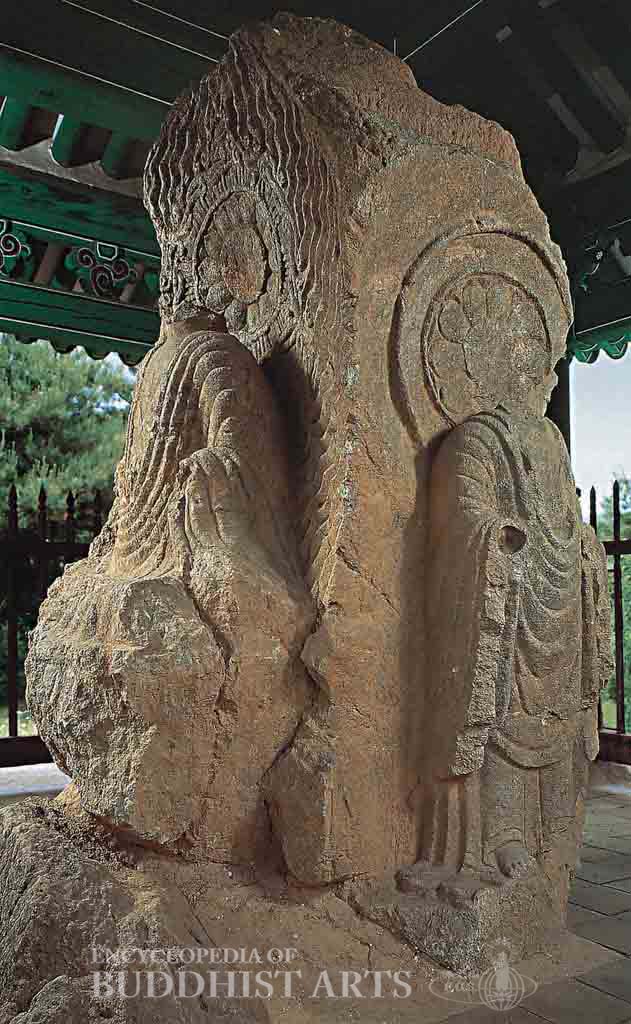
Hwajeonri Rock Carvings
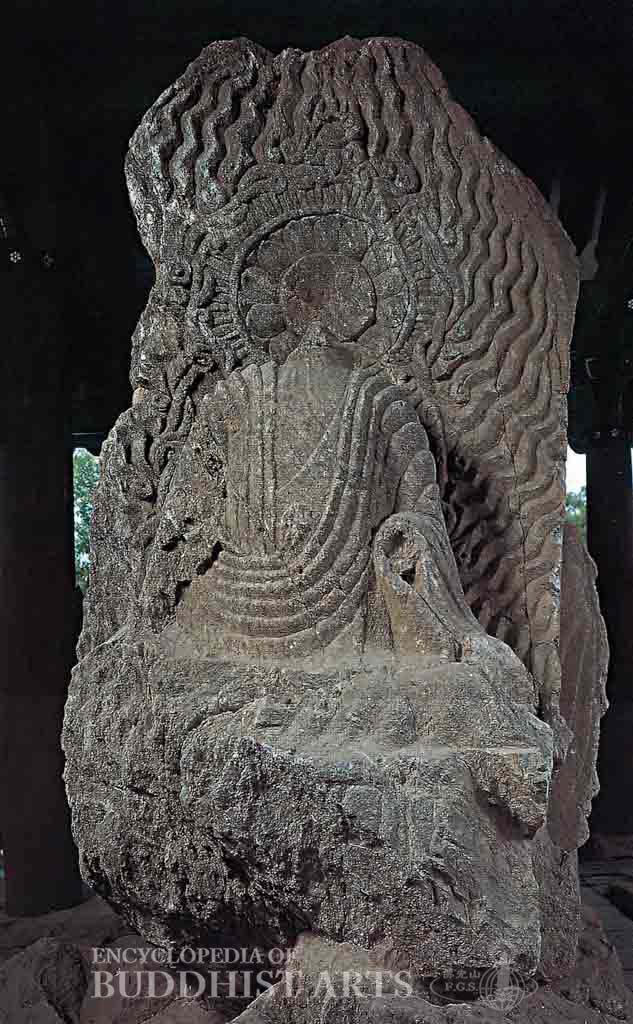
Hwajeonri Rock Carvings: Seated Buddha (south side)
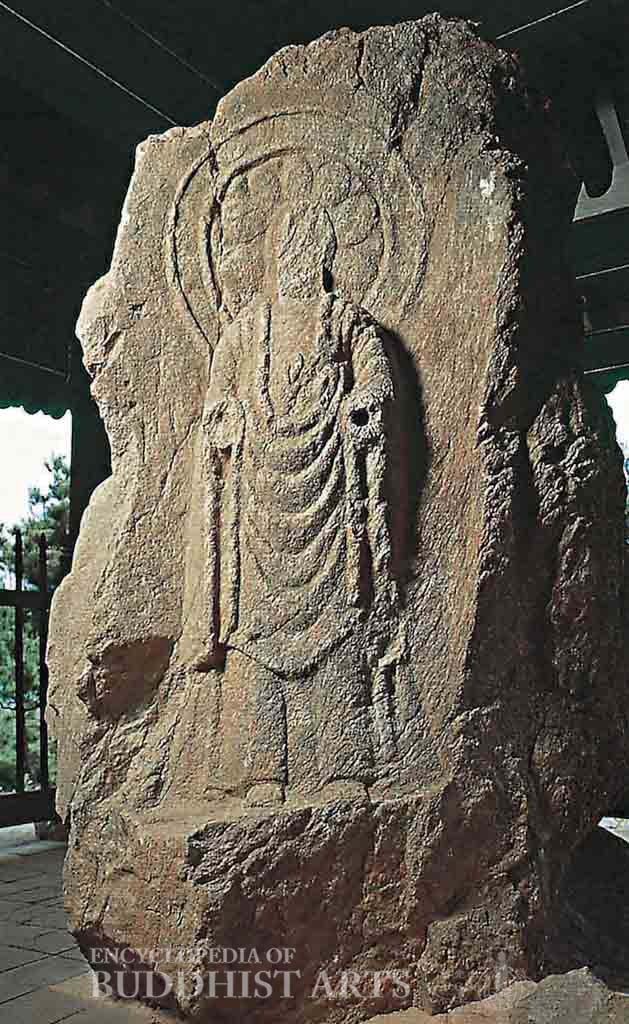
Hwajeonri Rock Carvings: Standing Buddha (west side)
Hwajeonri Rock Carvings
SOUTH KOREA, South Chungcheong, Yesan
The sculpture was created in the late 6th century to the early 7th century during the Baekje period (18 BCE–663 CE). It shows four Buddhas carved into the sides of a large boulder. It was listed as Treasure No. 794 in 1984.
While those on the other sides are standing, the Buddha facing south is seated and presumed to be the main figure. The 1.2 m high seated Buddha is adorned with an elaborate lotus nimbus surrounded by flames, and the heavy monastic robe falls in a series of deeply ridged folds. The adjacent standing figure is more simply portrayed and his lotus nimbus is surrounded only by a plain rim. The heads and the hands of all the figures are damaged, but judging from the arms, the hands probably form either the abhaya (fearlessness) mudra or the varada (wish-granting) mudra.
For more details, go to the Encyclopedia of Buddhist Arts: Caves R-L, page 429.
Cite this article:
author = Hsingyun and Youheng and Johnson, Peter and Mankuang and Huntington, Susan and Edson, Gary and Neather, Robert,
booktitle = {Encyclopedia of Buddhist Arts: Caves R-L},
pages = 429,
title = {{Hwajeonri Rock Carvings}},
volume = 6,
year = {2016}}