
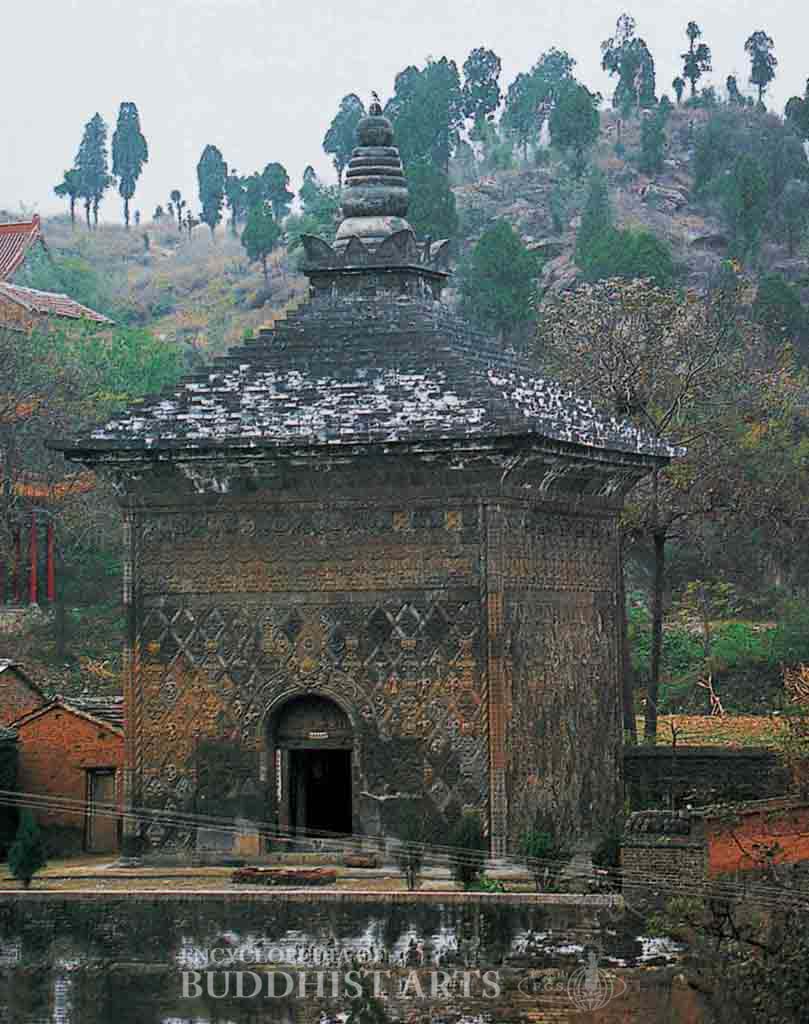
Xiuding Temple Pagoda
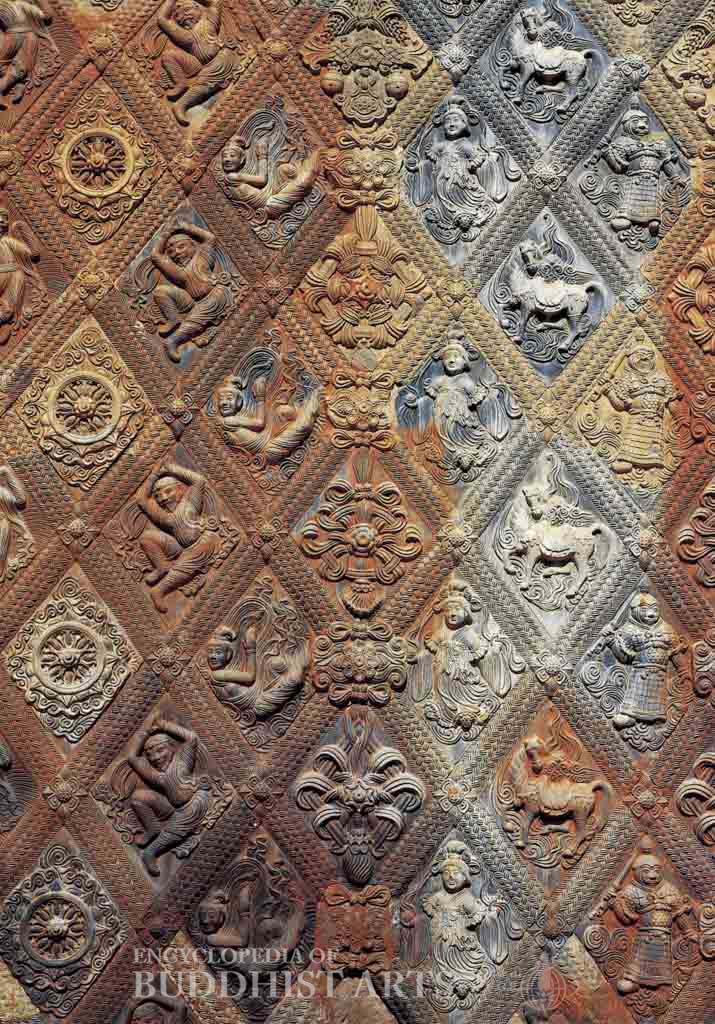
Xiuding Temple Pagoda: Brick Tiles
Xiuding Temple Pagoda
CHINA, Henan, Anyang
The pagoda is located at the foot of Qingliangshan (Cool Mountain) on the grounds of Xiuding Temple, which no longer exists. It is the only Tang dynasty (618–907) pagoda in China to be completely covered in decorated brick tiles. The construction year is unknown but, according to the records, the pagoda was already standing by 870. It was listed as a National Cultural Heritage Site in 1982.
The single-story, square, brick pagoda is about 20 m high. The pagoda body is 9.3 m high and the length of each side is 8.3 m. The walls are covered with 3,775 embossed brick tiles in different styles. Most of the brick tiles are diamond-shaped and depict subjects such as Heavenly Kings, warriors, apsaras, lions, elephants, and intricate floral motifs. The tiles along the cornice depict bells, tassles, and ribbons. Each side has the appearance of a piece of drapery. On the south side of the pagoda there is an arched doorway with a tympanum depicting the Three Buddhas. The square pyramidal roof is formed by reverse corbeling. It is surmounted by a spire consisting of a harmika, upturned lotus, inverted bowl, stacked rings, and jewel.
For more details, go to the Encyclopedia of Buddhist Arts: Architecture T-Z, page 1328.
Cite this article:
author = Hsingyun and Youheng and Johnson, Peter and Mankuang and Lancaster, Lewis,
booktitle = {Encyclopedia of Buddhist Arts: Architecture T-Z},
pages = 1328,
title = {{Xiuding Temple Pagoda}},
volume = 4,
year = {2016}}