
Gubyaukgyi Temple: Life of the Buddha - Return from Trayastrimsa Heaven
Gubyaukgyi Temple: Life of the Buddha - Return from Trayastrimsa Heaven
MYANMAR, Mandalay, Bagan
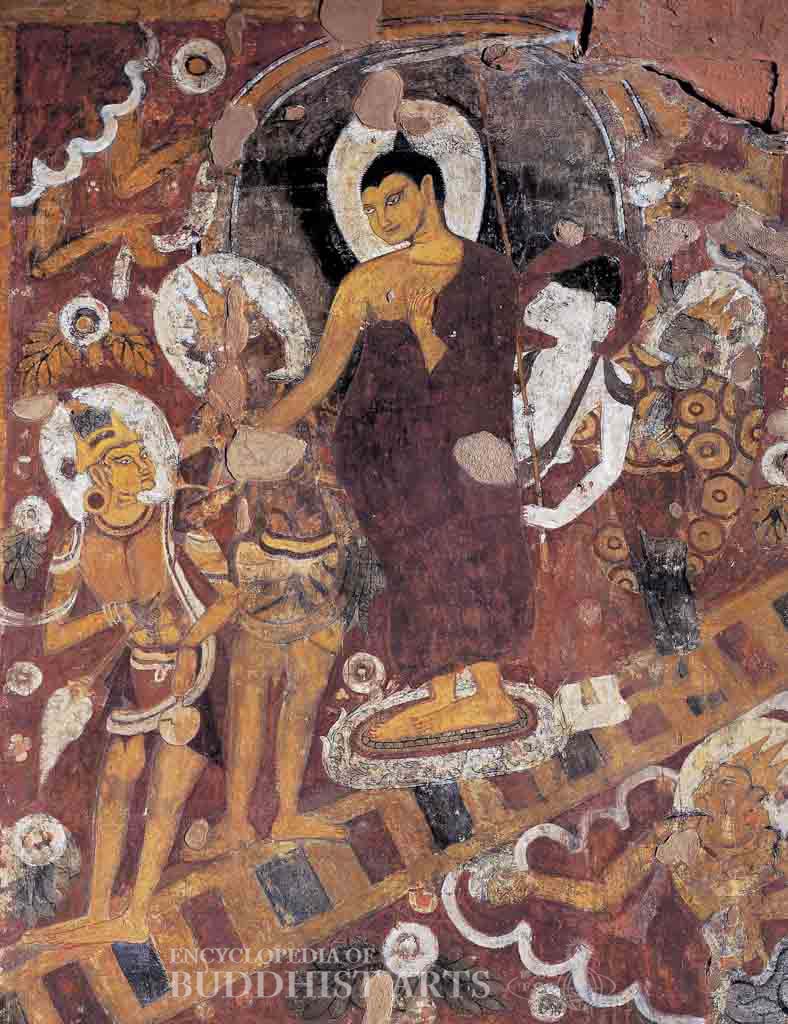
This fresco, painted during the Bagan Empire (circa 849–1287), is on the right side of the west wall at the portico of Gubyaukgyi Temple in Bagan. It portrays the Buddha returning to the human world from Trayastrimsa Heaven, where he had gone to teach the Dharma to his mother, Queen Maya. This is a commonly painted story from the Life of the Buddha. The depictions typically portray heavenly beings escorting the Buddha to the human world down a triple staircase decorated with gold, silver, and crystal glass.
In this mural, only one golden stairway is depicted. The Buddha stands on a lotus throne and wears a monastic robe draped over his left shoulder. The left hand is held up in front of his chest and the right arm is extended forward. The right hand is thought to have been forming the varada (wish-granting) mudra, but it has been obscured by damage. Sakra, wearing a golden crown, stands in front of the Buddha on the left, joining palms in reverence. Brahma, with white skin and three faces, stands on the right, holding a parasol. Three other heavenly beings are shown in the mural. One of them, depicted below the ladder, extends the right hand beneath the Buddha’s feet. The heavenly being on the far left wears a headdress and holds a whisk and a vase. The third heavenly being stands on the far right, with palms joined in reverence.
The white heavenly beings and the tan bodies of the Buddha and Sakra contrast with the fresco’s dark red background. The eyes of the figures have an upward tilt that is unique to Bagan Empire paintings.
For more details, go to the Encyclopedia of Buddhist Arts: Painting A-H, page 298.
Cite this article:
author = Hsingyun and Youheng and Youlu and Wilson, Graham and Manho and Mankuang and Huntington, Susan,
booktitle = {Encyclopedia of Buddhist Arts: Painting A-H},
pages = 298,
title = {{Gubyaukgyi Temple: Life of the Buddha - Return from Trayastrimsa Heaven}},
volume = 14,
year = {2016}}