
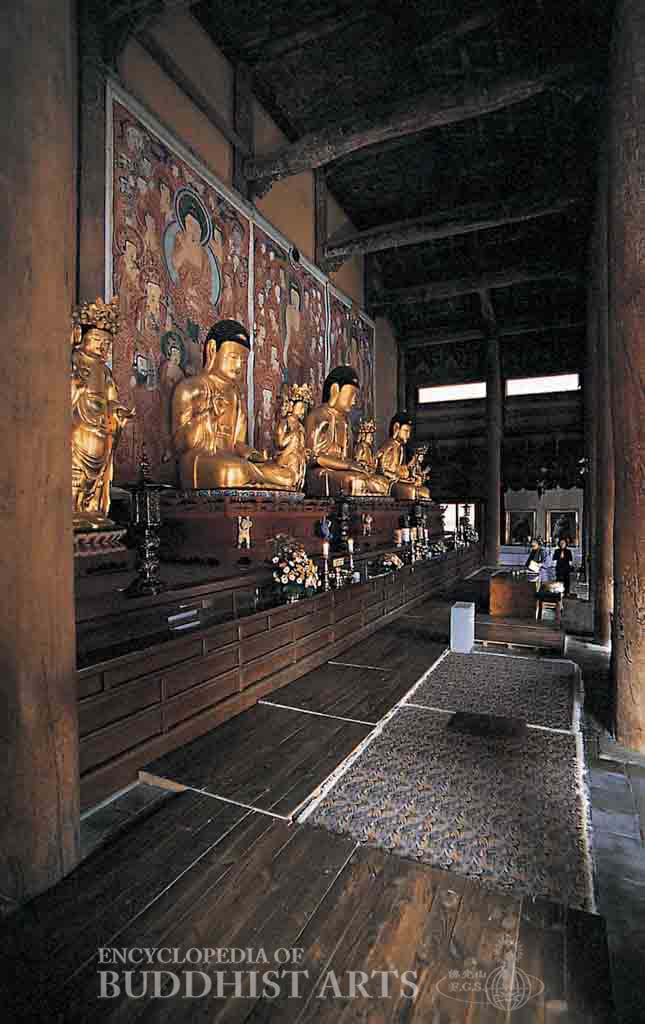
Hwaeomsa Temple Hall of the Enlightened Emperor Sculptures
Hwaeomsa Temple Hall of the Enlightened Emperor Sculptures
SOUTH KOREA, South Jeolla, Gurye; Joseon dynasty
Documents discovered inside the three Buddha and four Bodhisattva statues record that construction of the Hall of the Enlightened Emperor began in 1630 but was not completed. Seventy years later, twenty-six sculptors led by monk Saengnan finished carving the seven statues.
The three main Buddha statues sit in full lotus position on raised daises. Amitabha has the right hand in lotus mudra, Sakyamuni’s right hand is in bhumisparsa (earth-touching) mudra, while on the far side, Prabhutaratna has his left hand raised in lotus mudra. The four Bodhisattvas stand to either side of the Buddhas and they include Avalokitesvara, Samantabhadra, Mansjuri, and Ksitigarbha. They wear jeweled crowns and the folds in their clothing are molded in detail. The two Bodhisattvas to the left have their right hand raised and the left lowered, while this position is reversed for those on the other side.
Those responsible for the statues are named in the inscription: Saengnan personally sculpted Sakyamuni and shared work on Avalokitesvara with his disciple Chubung; Prabhutaratna and Manjusri were sculpted by Chungok; Amitabha was produced by Ilgi, Samantabhadra was created by Eungwon, and Ksitigarbha by Chupyeong.
For more details, go to the Encyclopedia of Buddhist Arts: Sculpture G-M, page 470.
Cite this article:
author = Hsingyun and Youheng and Lovelock, Yann and Chou, Yuan and Huntington, Susan and Edson, Gary and Neather, Robert,
booktitle = {Encyclopedia of Buddhist Arts: Sculpture G-M},
pages = 470,
title = {{Hwaeomsa Temple Hall of the Enlightened Emperor Sculptures}},
volume = 11,
year = {2016}}