
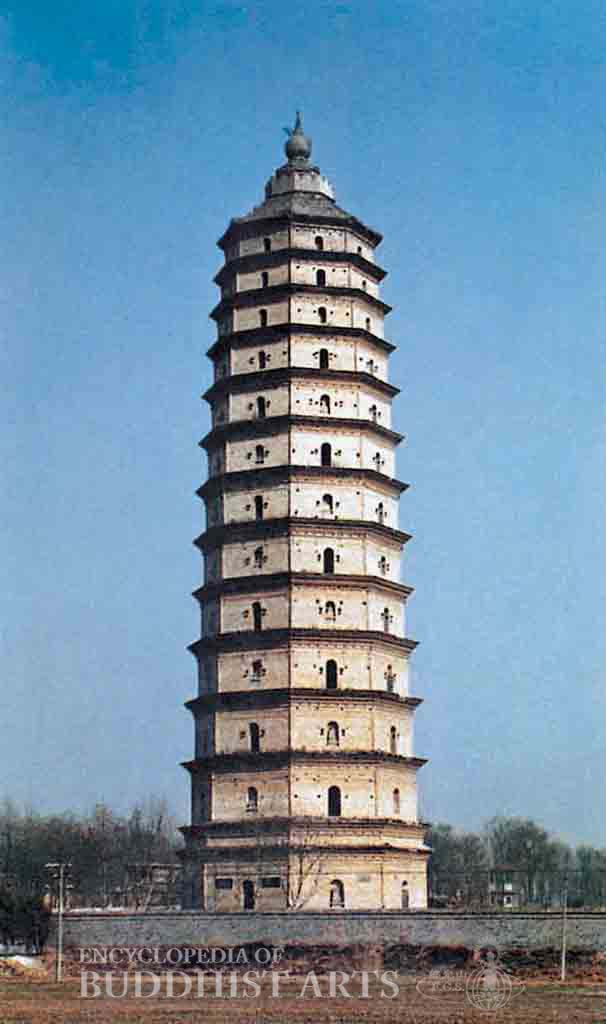
Chongwen Pagoda
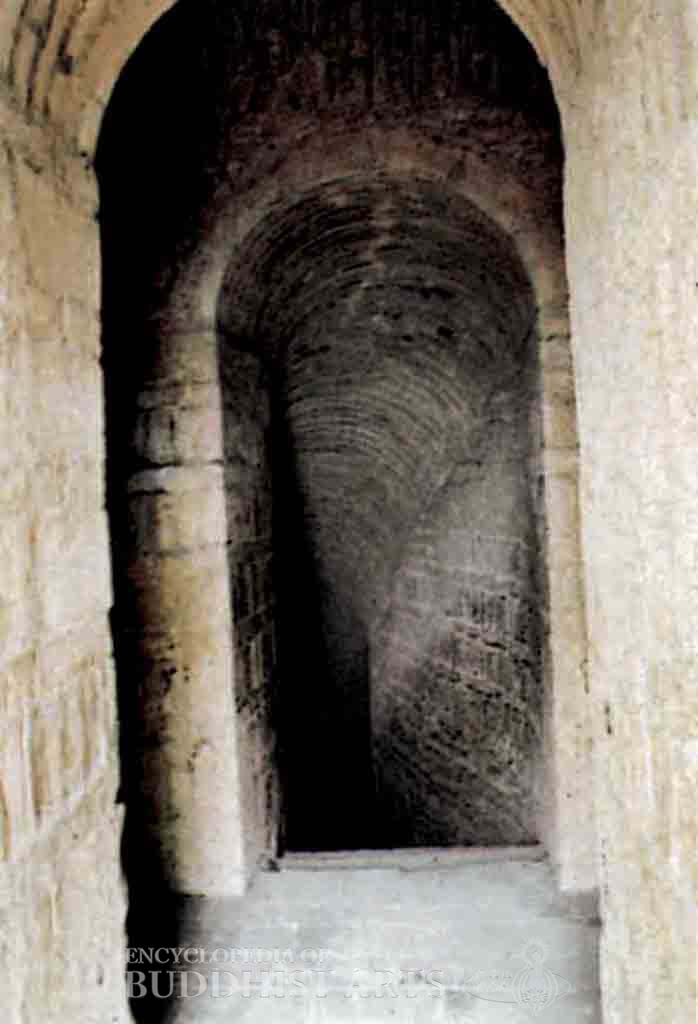
Chongwen Pagoda: Spiral Staircase
Chongwen Pagoda
CHINA, Shaanxi, Xianyang
The pagoda was built on the grounds of the Tiefo (Iron Buddha) Temple, which no longer exists. According to a stele inscription, its construction started in 1591 during the Ming dynasty. A story was added every year until 1605 when construction was completed. The names of the benefactors are engraved on each story. It is the second highest pagoda built in China before the modern era. It is listed as a Provincial Cultural Heritage Site.
The 13-story, octagonal, brick pagoda is 83.2 m high. Each side has a length of about 9 m at the base. The first story is the only one with double eaves. There is an arched doorway on the south side. The remaining sides have niches which contain a statue of a Buddha. From the second story upwards, there are four arched doorways and four niches, which alternate with each story. Lamp niches are located on either side of the doorways. The niches on the second to tenth stories contain Buddha statues. The corners of each story have rounded pilasters. The eaves are formed by corbeling, beneath which there are architectural features, such as rafter heads, bracket sets, and architraves. Stories two, four and six have an extra decoration in the form of inverted lotuses that are attached to the walls and divide each side into three bays. The structure has a single wall and is hollow inside. A spiral brick staircase reaches all the way to the roof. The pyramidal roof is formed by reverse corbeling. The spire consists of an octagonal harmika, an inverted bowl, a jewel, and a finial.
For more details, go to the Encyclopedia of Buddhist Arts: Architecture A-F, page 165.
Cite this article:
author = Hsingyun and Youheng and Johnson, Peter and Mankuang and Lancaster, Lewis,
booktitle = {Encyclopedia of Buddhist Arts: Architecture A-F},
pages = 165,
title = {{Chongwen Pagoda}},
volume = 1,
year = {2016}}