
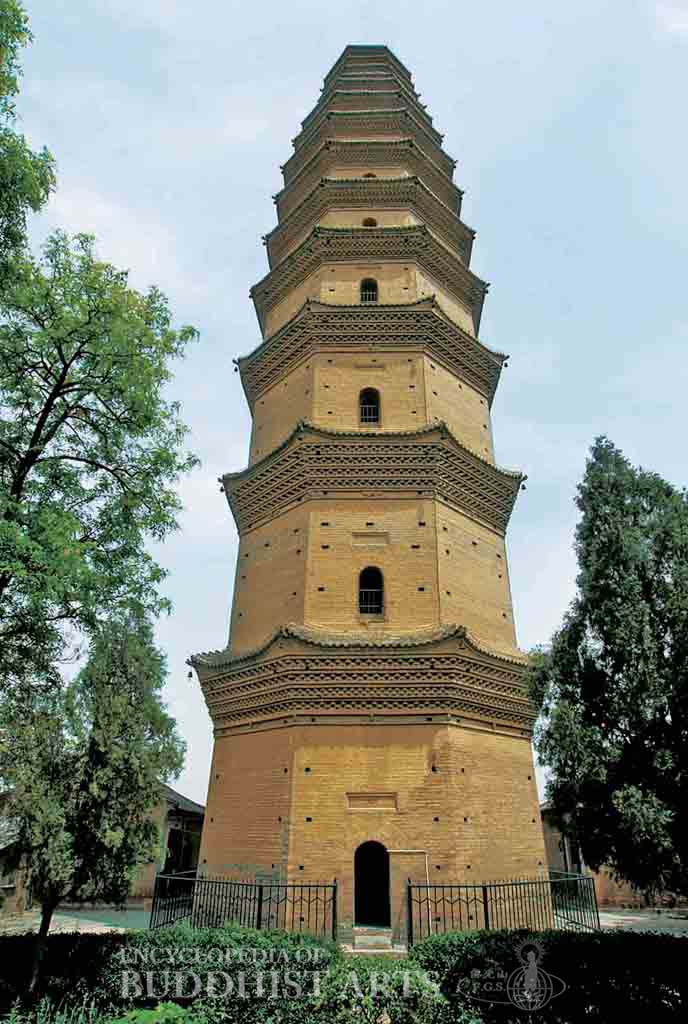
Sanyang Temple Pagoda
Sanyang Temple Pagoda
CHINA, Shaanxi, Xi’an
The pagoda was built on the grounds of Sanyang Temple, which no longer exists. According to a 1521 stele inscription recording the restoration of the temple, the pagoda was constructed during the rule of Emperor Xuanzong (reigned 847–860) of the Tang dynasty. The pagoda has undergone a number of repairs since the Ming dynasty (1368–1644). It was listed as a National Cultural Heritage Site in 2006.
The 13-story, octagonal, brick pagoda is 53 m high. The length of each side of the base is 4 m. Arched doorways are located on the north and south sides of the first story, while the second story has fake arched doors. The remaining stories, apart from the eighth, have arched windows on the walls facing the four cardinal directions. The lower stories are quite tall, but from the ninth story upwards their height decreases noticeably. The eaves are in the form of corbeling and courses of dogtooth bricks. The corners of the eaves are upturned slightly. The pyramidal roof is surmounted by a spire in the form of a vermilion vase. Inside are wooden stairs that lead to the roof.
For more details, go to the Encyclopedia of Buddhist Arts: Architecture M-S, page 944.
Cite this article:
author = Hsingyun and Youheng and Johnson, Peter and Mankuang and Lancaster, Lewis,
booktitle = {Encyclopedia of Buddhist Arts: Architecture M-S},
pages = 944,
title = {{Sanyang Temple Pagoda}},
volume = 3,
year = {2016}}