
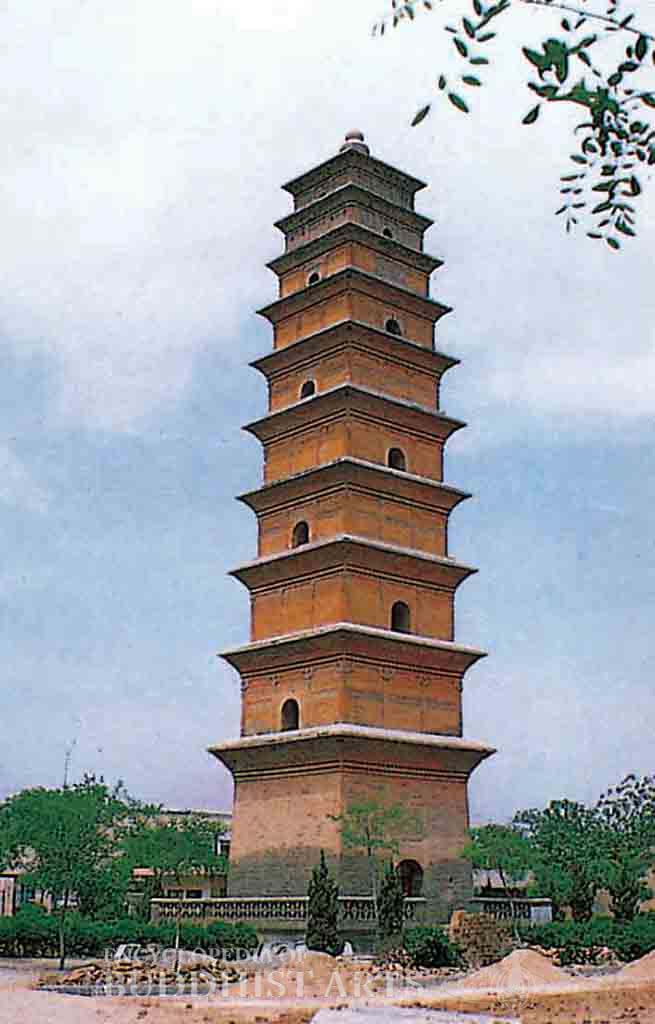
Pucheng South Pagoda
Pucheng South Pagoda
CHINA, Shaanxi, Weinan
The pagoda was constructed on the grounds of Huiche Temple, which no longer exists. It was built in 627 during the Tang dynasty. The earthquake of 1555 caused the pagoda body to crack and the spire to split in two. It was repaired in 1953 and was listed as a Provincial Cultural Heritage Site in 1957.
The 10-story, square, brick pagoda is 36 m high. The entrance to the pagoda is on the south side of the first story. Each side of the base is 9 m long. A stone statue of Sakyamuni Buddha from the Tang dynasty (618–907) is enshrined inside the chamber. On the remaining stories there are two arched openings on alternate sides. From the second story, each side is divided into three bays by brick pilasters, which are connected by architraves. The eaves are in the form of corbeling with courses of dogtooth bricks below. The roof is low and is surmounted by a spire in the shape of a vase. The whole structure is hollow with a single wall. There were once wooden stairs that reached to the top, but they were destroyed a long time ago. When the pagoda was reconstructed in 1953, wooden stairs to the third story were fitted.
For more details, go to the Encyclopedia of Buddhist Arts: Architecture M-S, page 843.
Cite this article:
author = Hsingyun and Youheng and Johnson, Peter and Mankuang and Lancaster, Lewis,
booktitle = {Encyclopedia of Buddhist Arts: Architecture M-S},
pages = 843,
title = {{Pucheng South Pagoda}},
volume = 3,
year = {2016}}