
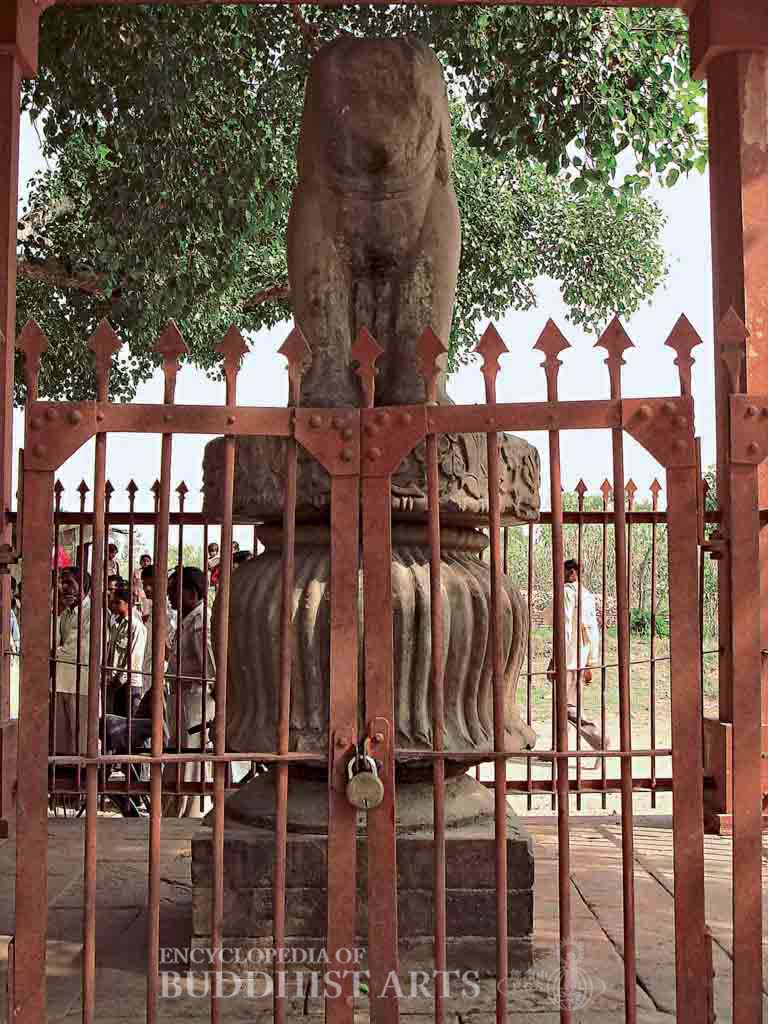
Sankisa: Capital of Asoka Pillar
Sankisa
INDIA, Uttar Pradesh, Farrukhabad
This site is also known as Sankasia or Kapittha, and is one of the major pilgrimage sites for Buddhists. This is the place where the Buddha descended from Trayastrimsa Heaven where he spent three months teaching the Dharma to his mother, Queen Maya. In 249 BCE, King Asoka (reigned circa 269–232 BCE) visited this place and built a shrine over the ladder on which the Buddha descended. He also constructed a stone pillar and a stupa near the shrine. When the Chinese pilgrim Master Faxian visited India in the 5th century, the place contained numerous monuments, including the Asoka pillar and shrine, a stupa in memory of the place where Utpalavarna Bhiksuni received the Buddha upon his return, another stupa in the place where the Buddha bathed after his descent, and a stupa to enshrine the hair and nail relics of the Buddha. In the 7th century, Chinese pilgrim Master Xuanzang visited the place and recorded the monastery, stupas and pillar found at the site. With the decline of Buddhism, the place was forgotten. British archaeologist Alexander Cunningham discovered this site in 1842.
The site presently contains ruins of a monastery, stupas, and other monuments, mostly consisting of piles of bricks and stones. The most interesting among them is the elephant capital of the Asoka Pillar. It is protected by a pavilion and surrounded by a fence. Next to the capital there is a small white shrine with an image of the Buddha flanked by Brahma and Sakra, depicting the descent from Trayastrimsa Heaven. Excavation has also revealed other items, such as a black stone carving representing the parinirvana of the Buddha, terracotta figures, stone dishes, and a variety of coins.
For more details, go to the Encyclopedia of Buddhist Arts: Architecture M-S, page 941.
Cite this article:
author = Hsingyun and Youheng and Johnson, Peter and Mankuang and Lancaster, Lewis,
booktitle = {Encyclopedia of Buddhist Arts: Architecture M-S},
pages = 941,
title = {{Sankisa}},
volume = 3,
year = {2016}}