
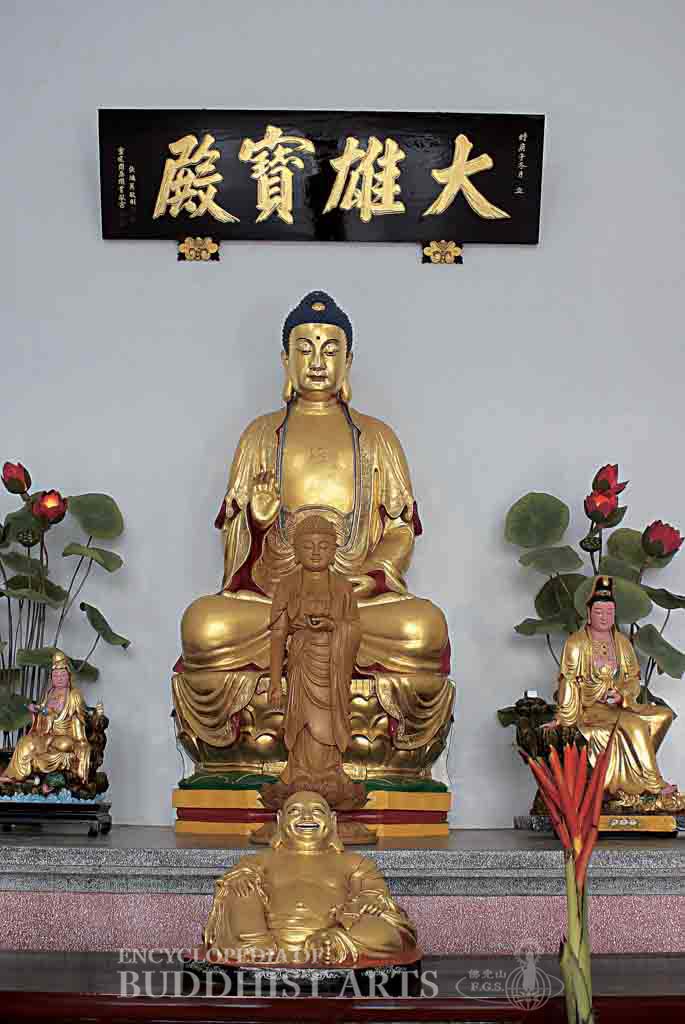
Jingang Temple Great Hero Hall: Sakyamuni Buddha
Clay
Jingang Temple Great Hero Hall: Sakyamuni Buddha
TAIWAN, Hsinchu
The statue may date from when the temple was built in 1922, or else from its reconstruction in 1953. It is one of the two works by the monk Miao Chan that survived the earthquake in 1999 which destroyed the temple.
The Buddha is seated in full lotus position on a deep lotus throne that rests on an octagonal base. The right hand of the figure is raised in abhaya (fearlessness) mudra and the monastic robe that covers both shoulders is opened to reveal the belted under robe. A swastika symbol can be seen on the chest. The statue was influenced by the Qing (1644–1911) style. The Buddha’s Thirty-Two Marks of Excellence are represented in the curled hair, the jewel beneath the usnisa, the urna, and the three lines on the neck.
For more details, go to the Encyclopedia of Buddhist Arts: Sculpture G-M, page 494.
Cite this article:
author = Hsingyun and Youheng and Lovelock, Yann and Chou, Yuan and Huntington, Susan and Edson, Gary and Neather, Robert,
booktitle = {Encyclopedia of Buddhist Arts: Sculpture G-M},
pages = 494,
title = {{Jingang Temple Great Hero Hall: Sakyamuni Buddha}},
volume = 11,
year = {2016}}