
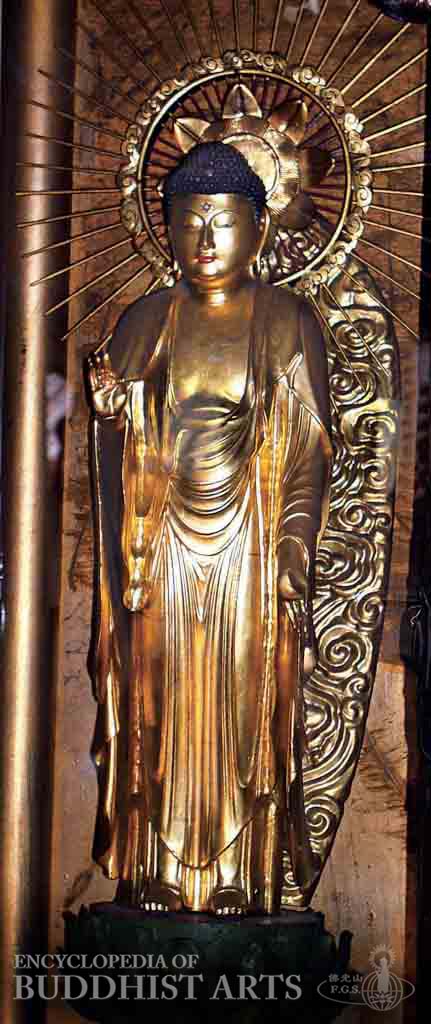
Amitabha Buddha
Wood
Amitabha Buddha
TAIWAN
The temple was once considered a branch of Honganji Temple, which followed the Japanese True Pure Land school, in 1903. The statue was brought from the main temple in Japan in 1905 and enshrined in a wooden house-like niche in the rear hall. It is of hollow construction, assembled from several pieces of wood, then coated with paint and gilded.
Amitabha wears a loosely-fitted monastic robe that covers both shoulders but is opened at the front. The fold ripple naturally down the arms and abdomen and then flow downwards to the lotus pedestal. Behind the figure is a typical Japanese boat-shaped aureole. The aureole intersects with a lotus nimbus with a cloud pattern surround that supports an openwork rayed effect created by rods that radiate from behind the lotus.
For more details, go to the Encyclopedia of Buddhist Arts: Sculpture A-F, page 33.
Cite this article:
author = Hsingyun and Youheng and Lovelock, Yann and Chou, Yuan and Huntington, Susan and Edson, Gary and Neather, Robert,
booktitle = {Encyclopedia of Buddhist Arts: Sculpture A-F},
pages = 33,
title = {{Amitabha Buddha}},
volume = 10,
year = {2016}}