
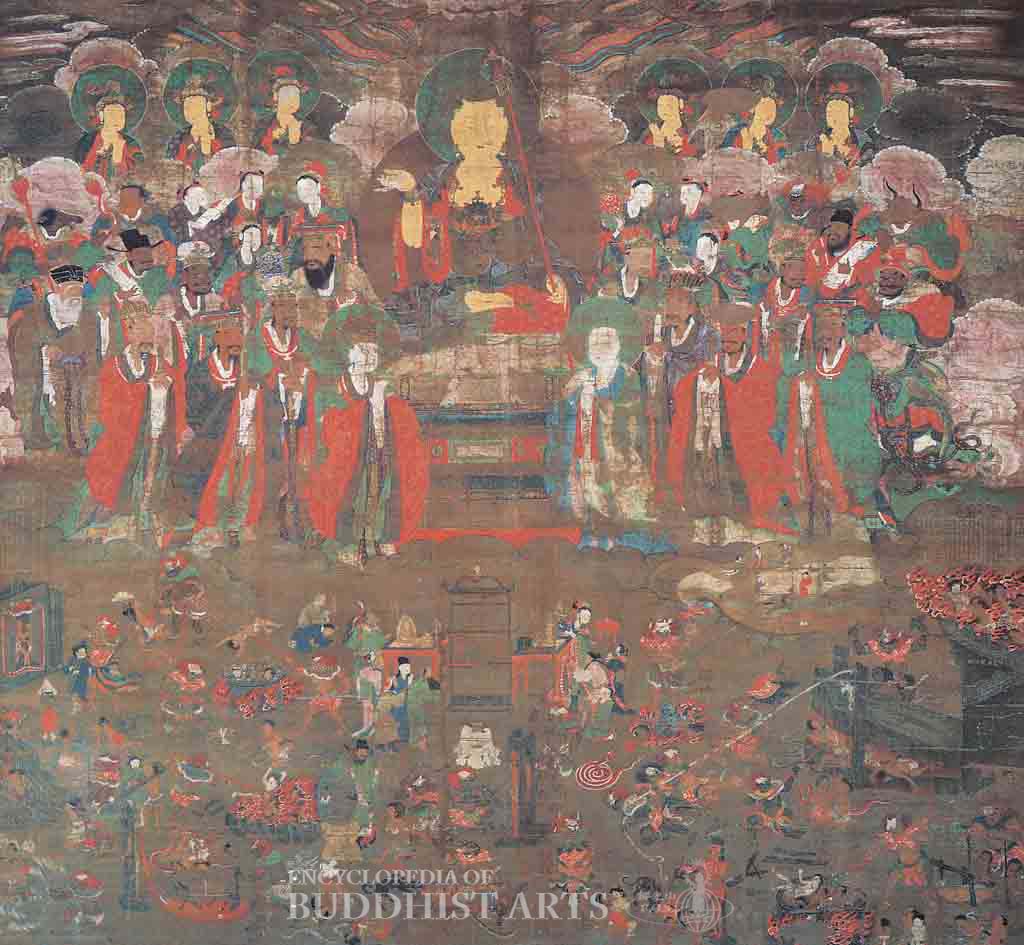
Illustration of the Ksitigarbha Sutra (detail)
Ink and color on silk
Illustration of the Ksitigarbha Sutra
KOREA; Joseon dynasty
According to the inscriptions written in gold on the two sides of the middle register, this work was painted in the second half of the 16th century during the Joseon dynasty. It was commissioned by the Royal Consort Suk of the Yun clan and the nun Jimyeong in prayer for the late Queen Insun, the Queen Consort of King Myeongjong (reigned 1546–1567). Upon completion, the illustration was kept in the Jasugung Sanctuary, an indication of the devotion to Buddhism felt by the women of the Korean royal family at the time.
The painting has distinct upper and lower sections. Ksitigarbha Bodhisattva and the Ten Kings of Hell are shown in the upper section, while 18 hells are depicted below. Ksitigarbha Bodhisattva sits in full lotus position on a Sumeru throne. Monk Daoming and Poisonless Ghost King stand on the sides in front of the throne with their palms joined in reverence. The Ten Kings of Hell, attendants, female figures making offerings, messengers, judges, Ox-Head and Horse-Face, and ghost soldiers stand in rows on the sides of the throne. In the back row, there are six Bodhisattvas surrounded by clouds. Below, the 18 hells are illustrated with grim scenes of punishment and suffering. The proportions of the figures in the two sections are very different; the beings in hell are small compared to Ksitigarbha and his assembly.
For more details, go to the Encyclopedia of Buddhist Arts: Painting I-O, page 374.
Cite this article:
author = Hsingyun and Youheng and Youlu and Wilson, Graham and Manho and Mankuang and Huntington, Susan,
booktitle = {Encyclopedia of Buddhist Arts: Painting I-O},
pages = 374,
title = {{Illustration of the Ksitigarbha Sutra}},
volume = 15,
year = {2016}}