
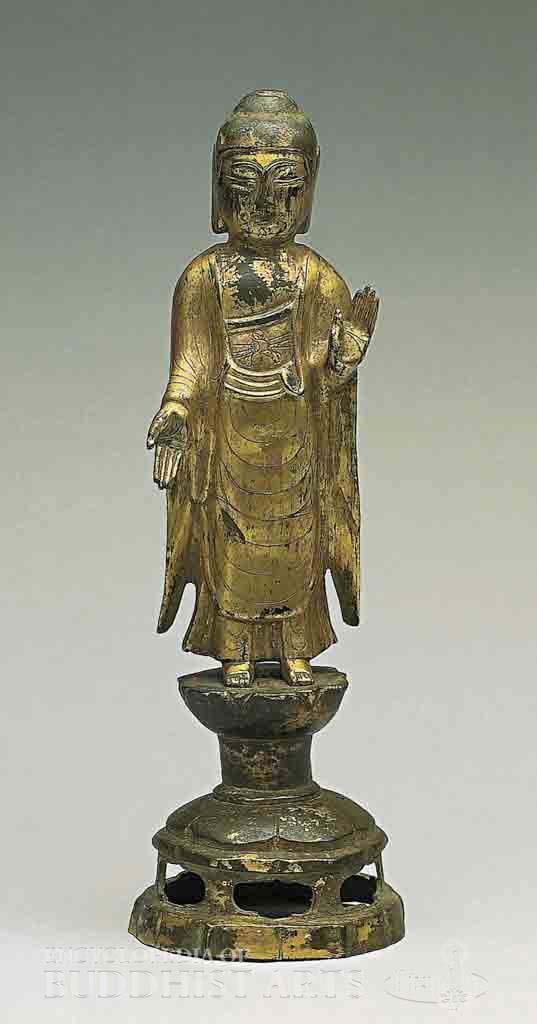
Standing Buddha
Gilt bronze
Standing Buddha
KOREA; Unified Silla dynasty
The facial contour of this standing Buddha appears square and flat. Many of the statue’s details were created by simple line incisions, a technique commonly used during late Unified Silla dynasty (668–935).
The Buddha’s monastic robe opens at the front to reveal an under-robe tied across the chest. The over-robe’s material folds down regularly and the hems are extended outward by the movement of the arms. The left hand is held diagonally in the abhaya (fearlessness) mudra, and the right hand is in the varada (wish-granting) mudra. The figure stands on a high Sumeru pedestal terminating in a reversed lotus that is supported on a polygonal base.
For more details, go to the Encyclopedia of Buddhist Arts: Sculpture St-Z, page 1144.
Cite this article:
Hsingyun, et al. "Standing Buddha." Encyclopedia of Buddhist Arts: Sculpture St-Z, vol. 13, 2016, pp. 1144.
Hsingyun, Youheng, Yann Lovelock, Yuan Chou, Susan Huntington, Gary Edson, and Robert Neather. 2016. "Standing Buddha" In Encyclopedia of Buddhist Arts: Sculpture St-Z, 13:1144.
Hsingyun, Youheng, Lovelock, Y., Chou, Y., Huntington, S., Edson, G., & Neather, R.. (2016). Standing Buddha. In Encyclopedia of Buddhist Arts: Sculpture St-Z (Vol. 13, pp. 1144).
@misc{Hsingyun2016,
author = Hsingyun and Youheng and Lovelock, Yann and Chou, Yuan and Huntington, Susan and Edson, Gary and Neather, Robert,
booktitle = {Encyclopedia of Buddhist Arts: Sculpture St-Z},
pages = 1144,
title = {{Standing Buddha}},
volume = 13,
year = {2016}}
author = Hsingyun and Youheng and Lovelock, Yann and Chou, Yuan and Huntington, Susan and Edson, Gary and Neather, Robert,
booktitle = {Encyclopedia of Buddhist Arts: Sculpture St-Z},
pages = 1144,
title = {{Standing Buddha}},
volume = 13,
year = {2016}}