
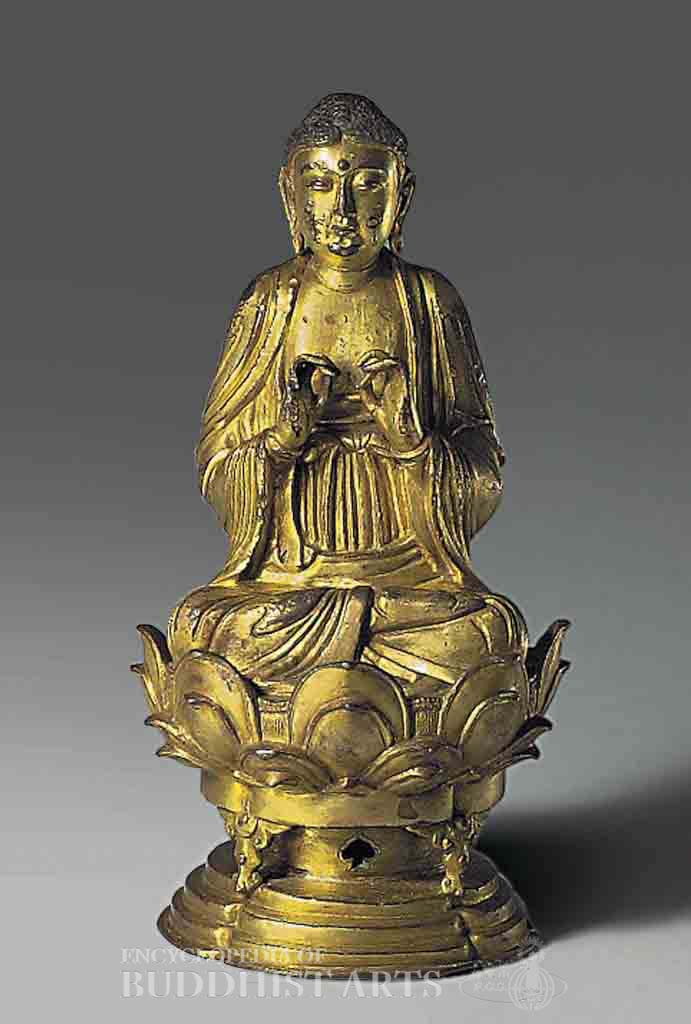
Seated Buddha
Gilt bronze
Seated Buddha
CHINA; Liao dynasty
Seated in half lotus position on a layered lotus throne, the Buddha is depicted with hands most likely in the middle grade of the middle class mudra, which may identify him as Amitabha welcoming devotees to his Western Pure Land. A gem is visible in front of the usnisa and an urna is located in the center of the forehead. The Buddha wears a monastic robe that opens at the front, where the knotted inner garment can be seen. The torso has a high waist line, presenting a higher ratio of lower to upper body, which shows a lessening of skill during the disruption following the fall of the Tang dynasty (618–907) at the start of the 10th century. The throne is supported on a four-legged circular base that rests on a stepped platform. The long, rounded face and the small features are similar to the Khitan people. The decoration located at the mid-section of the Sumeru base is something often seen in Liao dynasty (907–1125) statues.
For more details, go to the Encyclopedia of Buddhist Arts: Sculpture N-Sr, page 1011.
Cite this article:
author = Hsingyun and Youheng and Lovelock, Yann and Chou, Yuan and Huntington, Susan and Edson, Gary and Neather, Robert,
booktitle = {Encyclopedia of Buddhist Arts: Sculpture N-Sr},
pages = 1011,
title = {{Seated Buddha}},
volume = 12,
year = {2016}}