
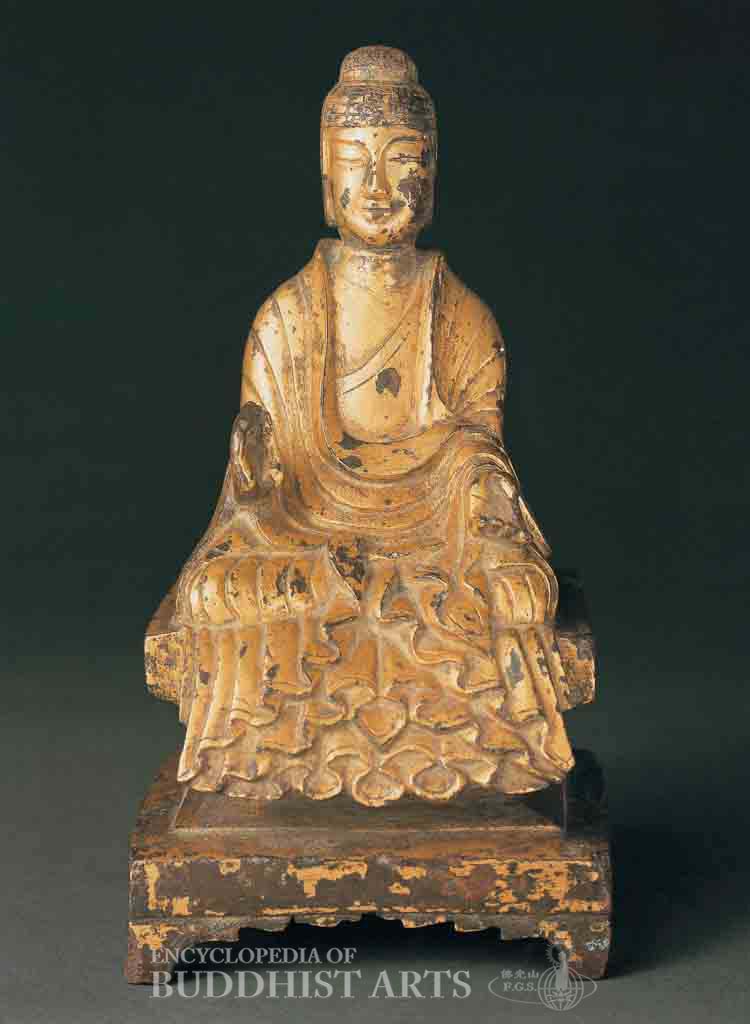
Sakyamuni Buddha
Gilt bronze
Sakyamuni Buddha
CHINA; Northern Qi dynasty
The Buddha sits in full lotus position on a Sumeru throne with hands in abhaya (fearlessness) and varada (wish-granting) mudras. The monastic robe opens at the front to show an inner garment and its voluminous stylized folds cascade over the throne. This style was carried over from the Northern Wei (386–534) and Eastern Wei (534–550) dynasties, and is typical of the 6th century. The hair is depicted by a rough pattern of incised squares in contrast with such lavish detail. A mortise hole on the Buddha’s back seems to indicate some former attachment. An inscription on the base states the statue was dedicated in 570 and identifies it as being Sakyamuni Buddha.
For more details, go to the Encyclopedia of Buddhist Arts: Sculpture N-Sr, page 914.
Cite this article:
author = Hsingyun and Youheng and Lovelock, Yann and Chou, Yuan and Huntington, Susan and Edson, Gary and Neather, Robert,
booktitle = {Encyclopedia of Buddhist Arts: Sculpture N-Sr},
pages = 914,
title = {{Sakyamuni Buddha}},
volume = 12,
year = {2016}}